Gilbert K. Chesterton Quotes
When you break the big laws, you do not get liberty; you do not even get anarchy. You get the small laws.
Chesterton, G. K. All Things Considered. Methuen & Co., 1908.


FULL QUOTE: “I have studied the law, and say again, I defy the united authorities of the earth to show where this people have not been loyal, wherein they have not proved loyal, in Germany, in France, in England, or in the United States; for they are the best people upon the face of the earth to observe the law and keep order. I want to live perfectly above the law, and make it my servant, instead of its being my master. That is the way to live; to be humble before God, and observe the laws; for there is no necessity of breaking the laws in America, in keeping the commandments of God. When the law is our master, the yoke is hard to bear; but when it is our servant, it works easy; whereas, if it be our master, we are continually compelled and driven by it.”


The term “magistrates” refers to chief executives such as Governors, Mayors, Kings, etc. and not members of a judicial branch per se. For example the President of the United States is sometimes referred to as the Chief Magistrate of the Nation.”

Justice Black would quote the 1st Amendment—"Congress shall make no law abridging the freedom of speech or of the press"—then slam his hand on his desk and exclaim:


those engaging in civil disobedience This was written in Scotland before Witherspoon emigrated to America. A major issue of political and religious debate at the time in Scotland was civil disobedience. “Reform” religious advocates argued for the moral propriety of civil disobedience where the protester’s conscience felt that the laws were immoral and unjust. The were referred to as “Moderates.” Witherspoon, early in his career, was one of the conservatives who argued then, against the Moderates, that civil disobedience should be punished very severely. The conservative rhetoric at the time sarcastically referred to protestors as having “tender consciences.” The issue was contentious then, later in America, and is so even today.

It is a common misconception that anarchists would not have any societal mechanism for preventing and combatting crime. Anarchists believe in the long run that with anarchism the reasons and motivations for crime will disappear, but until then they generally have been willing to use force to protect against force being used against the citizens. To critics, this seems to be government, and a government which uses force. Anarchists have never well detailed how they would manage such a seemingly conflicting situation.

It is hard for us today to understand why intelligent, thoughtful, people would seriously consider and even advocate anarchy. Yet there were many intelligent people who preached anarchy. The key to understanding this is that it is also hard for us to realize how terrible and actually dangerous was typical life under the Russian Government of the Czars. It was not only that most people were serfs--virtually slaves, but the government officials, the military and civilian both, could and did, abuse people in every way imaginable. In America today, if any of us were unfortunate to be the victim of violence, the odds are high that it would be at the hands of another citizen. In Russia (and other countries) at the time, the odds were that the perpetrator of the violence was a government official or government sanctioned person—police, military, aristocrats, civil officers. As but one example. Cossacks would frequently get drunk, pillage and rape a community and kill any who resisted—all with impunity. This quotation from Tolstoy is the classic argument of the anarchist at the time. It was impossible that the absence of government could be as bad as the government then was.

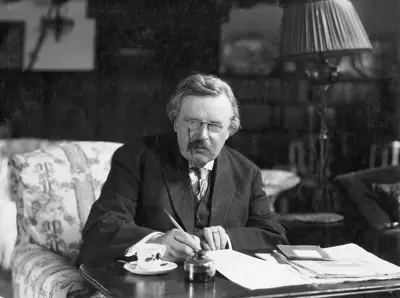
Gilbert Keith Chesterton KC*SG was an English writer, philosopher, lay theologian, and literary and art critic. He has been referred to as the "prince of paradox". Time magazine observed of his writing style: "Whenever possible Chesterton made his points with popular sayings, proverbs, allegories—first carefully turning them inside out."
