Wangari Maathai Quotes
I think what the Nobel committee is doing is going beyond war and looking at what humanity can do to prevent war. Sustainable management of our natural resources will promote peace.
Smith, Craig S. "Kenyan Ecologist Wins Nobel Peace Prize." The New York Times, 9 Oct. 2004.


The documentation of this quotation comes from a memorandum summarizing the meeting written by Presidential aide Harry Hopkins.


3rd Earl Russell of Kingston. The military weak nations agreed with him, but the militarily strong ones did not—especially America and England which had the Atomic Bomb when others did not.


She was instrumental in forming the United Nations, but one of its weaknesses was and has been since that it was very difficult and cumbersome for the UN to mount a military force to defend a country or region against aggression. The situation has not improved much on that score since 1948. Israel had just been created by the United Nations, but over a dozen Arab State armies attacked the fledgling Jewish nation. The Israelis, against all odds, not only defended their territory but were able to seize key Arab military and strategic areas. Mrs. Roosevelt, and most of the world, assumed that under the circumstances, the Arabs would negotiate a peace treaty with Israel to regain their land. However, the Arab nations would not recognize the State of Israel and would not even negotiate with the Israelis. ER and most of the world was wrong. Instead, the Arab nations’ strategy was to have a cease fire and build their military strength to attack later in greater force. When that also failed and Israel won the subsequent wars, the Arabs then turned to Terrorism. 60 years later, the Israelis and the Arabs were further apart in many ways than in 1948.
This was in the middle of the Cold War and the political leaders had to face the fact that their major military nuclear weapons, as a practical matter, could not be used. The result was not only too destructive but retaliation would produce MAD: Mutually Assured Destruction.


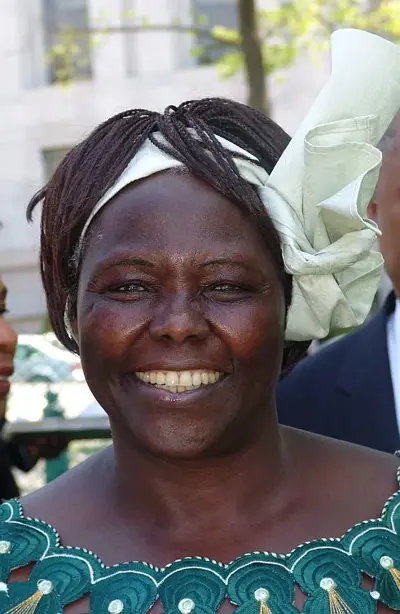
Wangarĩ Muta Maathai was a Kenyan social, environmental, and political activist and the first African woman to win the Nobel Peace Prize. As a beneficiary of the Kennedy Airlift she studied in the United States, earning a Bachelor's Degree from Mount St. Scholastica and a Master's Degree from the University of Pittsburgh. She went on to become the first woman in East and Central Africa to become a Doctor of Philosophy, receiving her Ph.D. from the University of Nairobi in Kenya.
