Chief Joseph Quotes
War can be avoided, and it ought to be avoided. I want no war.
Joseph, Chief. "An Indian's View of Indian Affairs." The North American Review, vol. 128, no. 269, University of Northern Iowa, Apr. 1879, p. 423.


Theodore Roosevelt was the Presidential nominee. Johnson was a leader of some members of Congress some of whom were extreme isolationists and some of whom were Nazi sympathizers and Hitler admirers. When the Japanese attacked Pearl Harbor later that year, Germany, fulfilling its treaty with Japan, declared war on America, Johnson’s group no longer mattered. Before WWII most Republicans were opposed to Defense Spending and accused the Democrats of being war hawks. After WWII, they flip flopped and became more hawkish than the Democrats who they accused of being soft on defense for years thereafter. See {631380} for President Roosevelt’s different view.

This was the week after he returned from his meeting with Hitler in Munich where he appeased the German Dictator. See {585941} for his famous naive statement.


This was in the middle of the Cold War and the political leaders had to face the fact that their major military nuclear weapons, as a practical matter, could not be used. The result was not only too destructive but retaliation would produce MAD: Mutually Assured Destruction.


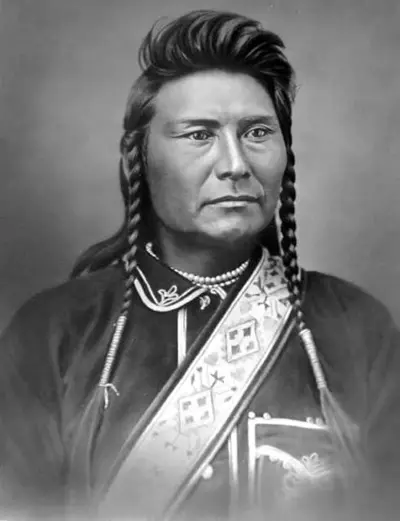
Hin-mah-too-yah-lat-kekt (or Hinmatóowyalahtq̓it in Americanist orthography), popularly known as Chief Joseph, Young Joseph, or Joseph the Younger, was a leader of the Wal-lam-wat-kain (Wallowa) band of Nez Perce, a Native American tribe of the interior Pacific Northwest region of the United States, in the latter half of the 19th century. He succeeded his father Tuekakas (Chief Joseph the Elder) in the early 1870s.
