Charles Darwin Quotes
I thank God, I shall never again visit a slave-country. To this day, if I hear a distant scream, it recalls with painful vividness my feelings, when passing a house near Pernambuco, I heard the most pitiable moans, and could not but suspect that some poor slave was being tortured, yet knew that I was as powerless as a child even to remonstrate.
Pernambuco is a state of Brazil. His voyage took him to several slave countries.
Charles Darwin, 1809-1882, English Scientist, XXI : Mauritius To England, The Voyage of the Beagle, 1839
Sourced by: Eigen's Political and Historical Quotations

Darwin was then a very young man, who had personal witnessed the slavery in South America and the Caribbean when he was on his famous expedition on HMS Beagle. See {630961} & {630962}. He was so disgusted with slavery that he hoped there would be armed slave revolutions and takeovers as had occurred in Haiti. Many of the English upper classes were radical when it came to slavery.
His voyage took him to several slave countries where his anti-slavery views were challenged by locals.


As an entertainer she had toured much of the world and seen American slavery and that of some other nations. She became a staunch abolitionist and like entertainers in the 20th and 21st centuries she used her celebrity to give anti-slavery lectures and perform for audiences where she donated the proceeds of the event to the abolition cause. She is a particularly interesting political figure in that she seems to be one of the first entertainers to perform for a social cause and become an activist.


Jefferson was then the United States Minister to France. While in Paris he was offered membership by M. de Warville in the Society for the Abolition of the Slave-Trade. Jefferson felt that he had to decline because his joining would have been seen as a politically polarizing act, inappropriate for an Ambassador of the American government which was divided on the issue of slavery. Some criticize the refusal and argue that this would have been the perfect act to push the abolition perspective, and question Jefferson’s sincerity about slavery as he not only refused to join the society, but never freed his own slaves though it is argued that he never made enough money to afford to emancipate them.

What was particularly interesting about this quotation is that Pinkney was a political leader of Maryland, a slave state. He saw the injustice and immorality of slavery but like many others of our founding fathers assumed that ending slavery would infringe on the property rights of the slave holders. Others argued that there can be no right to deny others their basic rights—property and wealth are subordinate to natural rights. See {632258} and {632259} for more on this point.

The language was removed in the negotiations that followed Jefferson's draft.


The general issued a military order emancipating slaves in Florida, Georgia and South Carolina. President Abraham Lincoln rescinded the order feeling it was too premature and it would cause the slave states that stayed in the Union--Delaware, Maryland, and Kentucky--to go over to the Confederates.

Many English slaves had been brought into Ireland by kidnappers and purchasers of English children as described in the quotation by Girald of Wales. The Irish kept them in bondage. In 1171 English invasions of Ireland appeared to be succeeding and the Irish clerics decided that they were being punished by God for the slavery. The edict was issued with the force of law. For insight into the common practice of kidnapping slaves in England, see Council of Westminster.


This was one of the first steps to ending of slavery in England. The council passed a number of general reforms from this to the prohibition of the clergy frequenting ale houses.


No sooner had Georgia Banned slavery, then some of the large planters petitioned the trustees for a reversal of the ban on the grounds that South Carolina, their neighboring colony allowed planters to use slaves and this put the Georgia planters at a major competitive disadvantage. Oglethorpe won the battle but later lost the war as the ban was overturned and Georgia became one of the worst slave states. What is interesting about this quotation is that in addition to his pragmatic reasons for banning slavery, he was morally offended but the notion and method of chattel slavery and the slave trade. See Quotes 643524 and 643525.

Southern secession and the Civil War This is one of the major quotations with which historians rebut the revisionist view that the Civil War was about States’ Rights or other economic factors.

It was then the practice of some men to engage in an attempted moral justification of slavery, including, in many cases, resorting to Biblical scripture and principles to argue that slavery was the will of God.


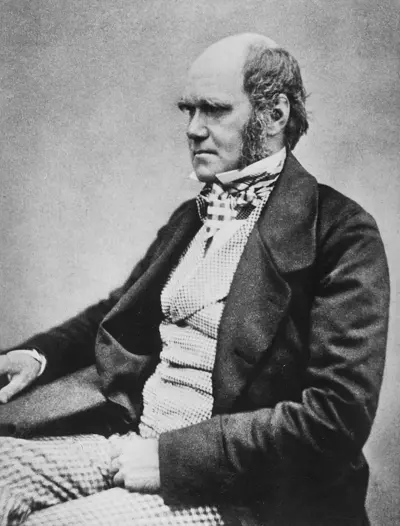
- Born: February 12, 1809
- Died: April 19, 1882
- Nationality: English
- Profession: Scientist
Charles Robert Darwin FRS FRGS FLS FZS was an English naturalist, geologist and biologist, best known for his contributions to the science of evolution.[I] His proposition that all species of life have descended over time from common ancestors is now widely accepted, and considered a foundational concept in science. In a joint publication with Alfred Russel Wallace, he introduced his scientific theory that this branching pattern of evolution resulted from a process that he called natural selection, in which the struggle for existence has a similar effect to the artificial selection involved in selective breeding. Darwin has been described as one of the most influential figures in human history, and he was honoured by burial in Westminster Abbey.
