Rutherford B. Hayes Quotes
I see more clearly than ever, and I thought I saw before, that congressional life is not the best introduction to the President's house. Great and fully equipped as the general [James Garfield] is, there are embarrassments growing out of his long and brilliant career in Congress, which Jackson and Lincoln, and Grant, and myself, escaped.
Rutherford B. Hayes, 1822-1893, 19th President of the United States (Republican, OH), Diary, April 25, 1881
Sourced by: Eigen's Political and Historical Quotations


Greeley was convinced that Lincoln could not win a second term against George McClellan and wanted to consider dumping Lincoln from the ticket and running someone else as the Republican nominee. Pundits have never been great predictors; Lincoln won.


The naval hero was approached as to his reception to a presidential draft. His famous response eliminated most interest in him. If Congress selected the President, he may well have won.

When the Senate was debating the Gulf of Tonkin Resolution, which would empower the President to take "all necessary measures" to repel any armed attack on U. S. forces, Senator Morse was one of only two Senators opposing the resolution:


Hamilton thought that the Executive Branch should be co-equal with the Judicial Branch and lifetime tenure should apply to both. This quotation is very important as we consider developing countries and emerging democracies. Some in the third world have Presidents for Life—a concept that most democracies scoff at. But the stability and the independence was important enough to some of the Founding Fathers was actually advocated and considered as we formed the American Democracy.

Although the Jacksonian Democrats were the political successors to the Jeffersonian Democratic Republicans, Jefferson found Jackson wanting as a potential president. Although Jefferson had made this statement during the 1824 Election, it did not become public until the Election of 1828 — Jackson’s second term. At that time Edward Coles, Formerly James Madison’s Secretary, disclosed the quotation.


This was the President’s original role regarding legislation. However, in the 20th century, Presidents have become more active and suggest laws and often initiate the process and then end it by signing the law that he suggested and shepherded through the Congress. But this was never the vision of the Founding Fathers, but since it is not addressed in the Constitution is not an unconstitutional process.

Alberto Gonzalez, White House Counsel and later Attorney General who was forced to resign and David S. Addington, Counsel to the Vice President, had come up with a novel view of the powers of the presidency. They argued that since the President is the Commander in Chief, in a war situation or intelligence gathering thereto, has the Constitutional responsibility for that function, he need not obey any laws of Congress as in the conduct of the war Congress would be impinging on the Constitutional separation of powers which itself was prohibited by the Constitution. The argument did not find any significant legal support but for a while the George W. Bush White House behaved as if this were the law, despite the fact that even in the American Revolution and the War of 1812 Congress passed laws regulating the conduct of the armed forces as is provided for in other parts of the Constitution. Yet even Goldsmith would allow the President some powers that many think are unconstitutional and/or belong to Congress. See {32436}.

He was alluding to Matthew 7:7; Luke 11:9, 12:31


The Congress over the last century has ceded much of its Constitutional power to the President. Congress has much power to check the President, but just as Congress has not been very competent at legislating, oversight, and conducting hearings and investigations, it has not organized itself to use the powers it has very well.

This quotation illustrates an interesting phenomenon in American Presidential Politics. There have been Democratic Presidents (FDR and Obama are the most glaring examples) for whom there was vituperative hatred and derision from the conservative Republicans who would frequently refer to them as Socialists and would believe that they were trying to lead the country on the path to socialism. The Presidents always stated that they were opposed to socialism, but to little avail with their conservative haters. But the socialists of the times and even the left wing of the Democratic Party not only did not see them as socialists, but were not very supportive or complementary of their skills and capabilities. Roosevelt reveled in the situation and “welcomed: their hate. Obama was more of a public centrist who tried to avoid the president getting involved in the extreme partisanship of the day.

His role was the equivalent of the Mayor of Washington DC. Even though the Congress had generally been the most powerful branch of the government, public opinion on this was beginning to shift at the turn of the 20th century.


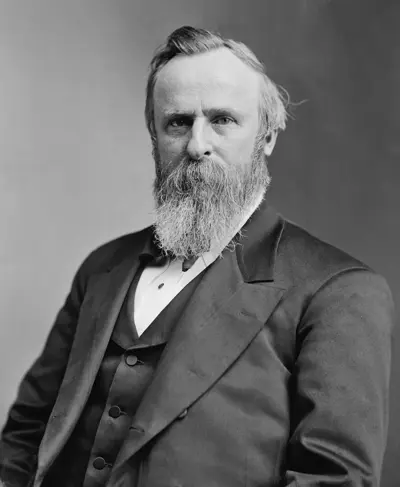
Rutherford Birchard Hayes was an American politician and attorney who served as the 19th president of the United States from 1877 to 1881, after serving in the U.S. House of Representatives and as governor of Ohio. A lawyer and staunch abolitionist, he had defended refugee slaves in court proceedings during the antebellum years. He negotiated the political agreement to end federal support of Reconstruction.
