Lyndon B. Johnson Quotes
I need to do anything I can for Charles Halleck. Now isn’t there something you can do?
Halleck was in the President’s office when he made this call. Johnson could not get the Civil Rights Bill out of the Rules Committee in the House as the Chairman was a Southern racist. The only alternative was a Discharge Petition where more than half the House members sign a petition to bring the Act to the floor for a vote. But earlier in an attempt to maintain Republican Party Discipline, Halleck—the Republican Leader—had publicly announced that any Republican who signed a discharge petition would be expelled from the party. However Purdue University was in Halleck’s District and they had started a program in Space Engineering. Halleck went to visit Webb and Purdue received a huge set of NASA grants and contracts to build up their Space Program. Halleck called Republican House members and told them that he had changed his mind about the discharge petition which was signed and filed shortly thereafter enabling the House to vote in favor of the Civil Rights Act of 1964. In a number of the future years, the selection of the NASA Astronauts was so stringent that only Purdue graduates were able to be selected.
Lyndon Baines Johnson, 1908-1973, 36th President of the United States (Democrat, TX), Telephone call to NASA Administrator James Webb, National Archives Tapes of White House Calls--1964
Sourced by: Eigen's Political and Historical Quotations


The President wanted Anderson to relay his message to other Republicans which he did. At that time the Southern racists were almost all members of the Southern bloc of the Democratic Party. Most Republicans were then advocates of non discrimination. By 2010 virtually all the racists, nativists, neo Nazis, anti Catholics, and anti Semites had gravitated to the Republican party if they were still active in politics. Reasonable Republicans were embarrassed as reasonable Democrats had been before the shift which resulted from passing the Civil Rights Act of 1964.

The Cloture motion was the motion to terminate the Southern Filibuster against the Civil Rights Act of 1964. Johnson needed substantial Republican support as the Solid Democratic South was all opposed to any kind of civil rights legislation. What is interesting is that Johnson, known as the champion arm twister, knew when to twist and when not to. Mundt, although a serious conservative and generally opposed to the Federal government controlling local human interaction, had also been a school superintendent and was a decent and fair-minded man who was personally offended by the over a century of unfair discrimination and overt racism. Johnson would either have Mundt’s vote from conviction or he would not get it, and pressure was not likely to work with him.


It was this oath that opponents of the Masons used to justify their beliefs that Masons were undemocratic. The Anti-Masonic party was formed in the early 1800s.
Johnson had proposed an extremely strong civil rights bill. Most Washington insiders assumed that he would gain favor amongst fair minded whites and Blacks for making the attempt, but then he would compromise with the Southerners, and water down the bill to something that had little or no teeth. His staff were trying to learn from Johnson, which aspects of the bill he was willing to compromise on assuming that the President could never get Congress to pass the bill in its original form. They were really surprised at the President’s answer and assumed that he could not do it. They were more surprised when he did drive the bill through Congress without any substantive compromises. It was the most powerful and effective Civil Rights legislation passed since Reconstruction a century earlier.
The Civil Rights Act of 1964 There was a major backlash in the South against the Civil Rights Act of 1964. Johnson, a Southerner himself, went right after the protesters.


Explaining his success as Majority Leader:

This quotation is a classic example of the type of deal making that President Johnson commonly engaged in.

He was responding to Mississippi Congressman William Colmer-- {637395}. Southern racists frequently accused other members of Congress of being intimidated by civil rights leaders rather than voting for civil rights legislation out of conviction. Many of them, like Colmer, were so insular that revanchist that they did not realize that other whites could really believe that segregation was not a necessary and good thing.

Weltner was the only Georgia politician who urged state compliance with the Federal Civil Rights Law of 1964. (See {637605}.) The others advocated disobedience, crime, and obstruction, particularly the Democratic Party Candidate for Governor Lester Maddox who also advocated racial violence and had a history of it himself. Weltner refused to support Maddox, and the Democratic Party then instituted a loyalty oath for all party candidates where they promised to support and campaign for all party candidates on the ticket. Welter refused to sign the oath and support Maddox, and therefore gave up the Democratic nomination which at the time virtually guaranteed a win. (Soon after, the segregationist politicians of the South accepted the Republican invitation to switch parties and since then the remaining racists and anti-civil rights politicians run as Republicans.

Roosevelt was such a breath of fresh air as a politician that cynical political journalists saw him as almost a savior of American politics at the time. His dynamic personality, independence from outside influence, and his enthusiasm for reforming the out of control corporate dominated society without destroying the corporations like Bryan and the populists, attracted many who had never before supported any politician.
The things that makes this quotation historically important is how fast Cixi was adopting modern technology as a tool to manage the government and how she was managing day to day the significant international negotiations taking place on the other side of the earth. While in most areas Chinese bureaucracy was notorious for obstructionism and delay, Cixi maintained direct and almost real time control of the parts of the government that she felt most important. She resembled Abraham Lincoln in the sense that they both found innovative ways to use new technology to enable them to better and more directly manage and control the government.

The threat was delivered to Mark Sanford a conservative Congressman from Southg Carolina, Sanford had stated that he would vote against Trump's plan for a replacement to Obamacare. He paid no attention to the threat and the intent of intimidating other Republican members of the House of Representatives failed, There were so many Republican defectors who would not vote for the bill that House Speaker Ryan, withdrew the bill at the last minute has the majority Republicans had so many defectors that the Obama Care replacement coult not possibly pass. This was a great blow to Presieent Trump and not President in history had been thwarted so early in his administration on a major bill. Worse Trump's own party contolled the majority and the entire party had run their campaingns with the "promise" to repeal ObabaCare. However when they tried to do it, they cound it was not so easy and even most of the conservatives proferred ObamaCare to the propsed legislation that the Speaker or the House and the Presidenet were advocating.


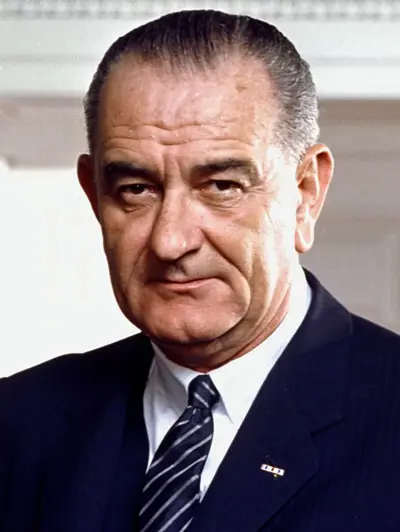
Lyndon Baines Johnson, often referred to by his initials LBJ, was the 36th president of the United States, in office from 1963 to 1969. He served as the 37th vice president from 1961 to 1963 and assumed the presidency following the assassination of President John F. Kennedy. A Democrat from Texas, Johnson was also a United States representative and later majority leader in the United States Senate. Johnson is one of only four people to have served, at various times, in all four federal elected positions.
