Christopher Hitchens Quotes
I love it when Muslims go to war with each other, as I do when the Christians do, because it shows there's no such thing as the Christian world and the Islamic world. That's all crap.
Hitchens, Christopher. Hitch-22: A Memoir. Twelve, 2010.


While not in the Koran, this attributed statement is the basis for the ban on non-Muslims going on a Hajj and going to the most holy Muslim places—Mecca, Mina, Muzdalifa, and Arafat as well as the anti-religious hostility to all religions but Islam which is present in some Muslim countries.

Locke wrote the Charter of South Carolina in which any 7 people could assemble and form a church including:


His protest was focused on Middle East policies which he believed did not value the lives of Muslims as highly as Christians and Jews. The irony of this protest is that United States policy claims to value all life equally as do virtually all industrialized democracies. Omeish however is unusual among world Islamic leaders and politicians in that he values Christian and Jewish life as much as Muslim. Most, typically value Muslims almost exclusively and many advocate the killing of Christians and Jews.

This was the beginning of the inquisition.


Followers of the religious views of January Hus, 1369-1415 Hus was excommunicated and executed for his views that parts of the church were corrupt.

Ariel Sharon, before he became Israeli Prime Minister was an Army General, who led the attack on the Palestinian PLO terrorists in Southern Lebanon. He had made an alliance with the Lebanese Christian Phalangists who had been brutalized and many had been murdered by the PLO militants who operated out of the Sabra and Shatila Beirut refugee camps where the terrorists had a safe haven and their PLO headquarters in Shatila. Israeli troops under Sharon had reached Beirut, and then the Phalangists attacked the two refugee camps where they had scores to settle and sought revenge. Somewhere between 700 and 3500 Palestinians were killed. Most of them were civilians (according to the Palestinians) or terrorist fighters (according to the Phalangists). Sharon was faulted by many for the deaths; these critics observe that Sharon, as the victorious military power in the area was responsible according to the rules of war for the safety of all civilians in the area. He commanded the strongest military in the area and he allowed or did not stop the Phalangists who were exacting their revenge. Therefore some accused him of war crimes. There was also an Italian military peacekeeping contingent in the camps but they chose not to intervene.

The Ottoman Empire was a word Superpower for over 1,000 years, longer than any other in history, One of its great strengths was its pluralism and ability to not only absorb and assimilate people from other nations, cultures and religions, but also to utilize those people in key positions and contributions to their society. Christians and Jews rose to the highest positions under the Sultans. They became Governor’s of Provinces, manages of departments and even Grand Vizier to the Sultan himself. Jewish and Christian physicians, attorneys, traders were all valued in the Empire even though the had a second class status relative to Muslims. The opportunity was always there to convert to Islam and many did, but many did not and thrived, The Ottomans saw Christian Europe, not only in continuous religious conflict, but individual nations were never able to use the talents of the religious minority, the way that the Ottomans did, and later the United States did. Not only did the Ottomans allow immigrants from all over the world to become part of the Empire Government or Economy, but they actually send agents throughout the empire to find the best and the brightest of young men—regardless of religion or nationality—and bring them to the Sultan’s court for education, training and service. IT should be noted however, that the motivation was in no way moral or a desire for fairness. It was totally pragmatic. Exceptional manpower was not to be wasted.
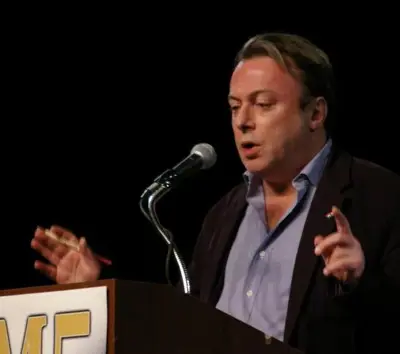
Christopher Eric Hitchens was an English-American intellectual, polemicist, and socio-political critic, who expressed himself as an author, orator, essayist and columnist. He wrote, co-wrote, edited or co-edited over 30 books, including five of essays on culture, politics and literature. Having contributed to several publications, he is broadly regarded as one of the most influential atheists of all time.
