John Kerry Quotes
I know something about aircraft carriers for real.
Kerry, John. Campaign Speech, 2004.


He was not aware of it but the Union War Department had prepared well and additional ironclad ships under construction of which the Monitor was just the first. Lincoln had approved the construction of ironclads on October 4, 1861. The Confederate Merrimack was larger and to the layman was the stronger ship but the Monitor did some damage and drove the Confederate Merrimac from the field to make repairs. The Confederacy, with minimal industrial steel-making capacity could not produce enough steel to protect more ships than the one ironclad Merrimack. The Union Navy, not only were building more Monitor class ships, but also, had a few Merrimack type wooden ships being iron clad as well as their Monitors as Strong had called for. The Union soon totally dominated the seas and as important, the rivers with which they could supply Union troops and bombard Confederate cities built thereupon.

Dreadnoughts were huge battleships. Britain had the dominant navy of the world and controlled the seas. A European war would be a land war where a navy would be of little use. Hence, Britain would not want to get involved in such a war where she could not use her greatest military strength. He was wrong about this and so much else. Britain entered WWI when Germany invaded Belgium fulfilling her treaty obligations. The Germans intelligence operators and analysts were well aware of the treaty obligations, but had little understanding of English culture and tradition. The German aggression against a small power like Belgium was morally offensive to many in Great Britain, and Britain had a tradition of fighting for moral principles. The Germans would never militarily disadvantage themselves for the sake of a treaty obligation to a small nation, and they did not believe that the British would be so different and fulfill their treaty obligations even though their strongest military asset—their navy would not be very helpful.


Koxinga had an overwhelmingly superior force, and wanted the Dutch to surrender and avoid bloodshed. The Dutch with their typical European colonial attitude, had great difficulty surrendering to “natives” even if outnumbered. Finally, the Dutch Commander agreed to surrender. Koxinga then established a Chinese Government on the Island and became a great hero of the Ming Dynasty. Note the graphic of the statue to him which is one of the very few Chinese memorial statues to a military hero showing him in action—very similar to European statues. Already Koxinga’s massed wooden junks with small cannon and fire torches had sunk one of the Dutch warships (they were not iron but had some iron plates on the deck to protect the gunners) and there were so many junks that the other Dutch ships sailed out to sea to avoid the Chinese huge number of junks.

This quotation shows that the French revolutionaries wished for an invasion of England, even before Napoleon came to power. Part of the reason was the traditional enmity between France and England, even before the French Revolution, and the other part that England was covertly working against the French Revolution and ideologically stood for monarchy and inequality, while the French of the time were Republicans for whom equality was not only an ideal, but part of the law and much of post-revolutionary reality.

Most Americans do not realize that our naval forces were disbanded after the Revolution and even the Constitution did not require a navy. We had some Federal revenue cutters to interdict smugglers but no warships and no permanent sailors or officers. The Barbary Pirates had an incredible extortion racket going in the Mediterranean. If nations would pay them an annual sum each year, they would not attack and seize merchant ships of that country and sell the ships and goods while holding the sailors for ransom. See {640850},86703,{640846} & {640848}


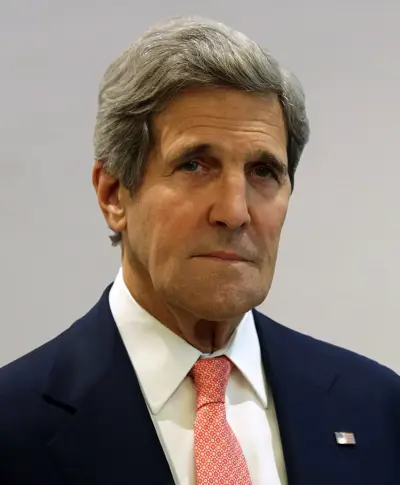
John Forbes Kerry is an American politician and diplomat serving as the United States Special Presidential Envoy for Climate. He previously served as the 68th United States Secretary of State from 2013 to 2017. An attorney and former naval officer, Kerry first drew public attention as a decorated Vietnam veteran turned anti-war activist. He went on to serve as a prosecutor and as Lieutenant Governor of Massachusetts, before serving as United States Senator from Massachusetts from 1985 to 2013. A member of the Democratic Party, he was the Democratic nominee for President of the United States in the 2004 election, which he lost to incumbent President George W. Bush. He is the last Democratic presidential candidate to date to lose the popular vote.
