Donald Rumsfeld Quotes
Is it likely that an aircraft carrier or a cruise missile is going to find a person?
Rumsfeld, Donald. "DoD News Briefing." United States Department of Defense, 2001.


There were few military thinkers at that time who would agree with Goebbels on this point.

As in modern times the Navy encouraged the media and leading writers to promote their latest weaponry. Hawthorne however shortly after the Monitor and the Merrimac battle saw the future in terms even more dramatic than most of the military.

At the time, most Japanese (and American and worldwide) Naval leaders and strategists believed that it was the battleship that was the critical naval weapon. Yamamoto proved to be correct and ironically, the American Aircraft Carriers and Planes were his undoing.

This quotation not only gives us an interesting description and reaction to the first generation of ironclad ships, but we get an insight into the amazingly open access that was available to the most important new weapon of the Union. Apparently, there was still hope of a Southern cessation of fighting and rejoining the Union, and the aim was to get as much publicity about the new weapon as possible to the Confederates to persuade them of the futility of their situation. The North could manufacture as many of these vessels as they needed, while Confederates could only refit wooden ships with metal siding. There were few ships that were suitable for such refitting and the ironworks of the South were limited and needed for cannon, railroad tracks and other uses all competing for limited production capacity. Hawthorne went on board the Monitor without making any special arrangements at all. He just showed up and went aboard.
David Bushnell, 1740–1824, was a student at Yale University where he developed the first submarine used in warfare. While at Yale, Bushnell proved that gunpowder could be exploded under water. He also made the first time bomb. He combined these ideas by building the Turtle which was designed to attack ships by attaching a time bomb to their hulls, while using a hand powered drill and ship auger bit to penetrate the hulls. He used the Turtle in attempts to attack British ships which were blockading New York Harbor in the summer of 1776. His efforts failed every time because the Turtle's boring device was unable to penetrate the copper sheeting lining in the ships' hulls which was designed to protect against parasites in their previous station, the Caribbean. (From Wikipedia)

He was the author of the first “spy novel” and one of the first English writers to use his art and craft to promote public opinion to support more military spending to defend against Germany.


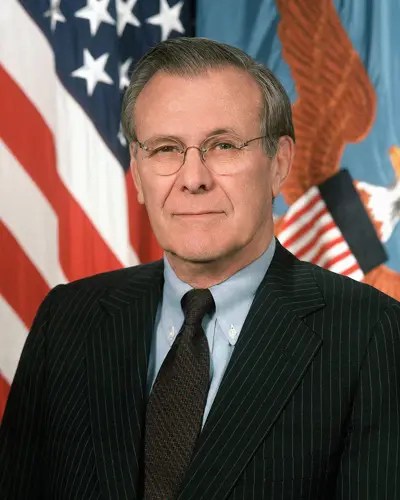
Donald Henry Rumsfeld is a retired American politician. Rumsfeld served as Secretary of Defense from 1975 to 1977 under Gerald Ford, and again from January 2001 to December 2006 under George W. Bush. He is both the youngest and the second-oldest person to have served as Secretary of Defense. Additionally, Rumsfeld was a three-term U.S. Congressman from Illinois (1963–69), director of the Office of Economic Opportunity (1969–70), counsellor to the president (1969–73), the United States Permanent Representative to NATO (1973–74), and White House Chief of Staff (1974–75). Between his terms as Secretary of Defense, he served as the CEO and chairman of several companies.
