Hiram Rhodes Revels Quotes
I hold that establishing mixed schools will not harm the white race. I am their friend. I said in Mississippi, and I say here, and I say everywhere, that I would abandon the Republican party if it went into any measures of legislation really damaging to any portion of the white race, but it is not in the Republican party to do that.
United States, Congress, Senate. Congressional Globe. 41st Congress, 3rd Session, Office of the Congressional Globe, 1871, p. 1060.


The Quakers were in the forefront of not only the abolition of slavery but of the integration of the races.

Eight years and a Civil War later, he had changed his mind and was the sponsor of the Civil Rights Act of 1866—the first Federal civil rights law in America. See {587711}.

This quotation was one of the major reasons Carswell was rejected by the Senate.


This quotation illustrates one of the earliest major political dirty tricks. The pamphlet was published supposedly as a Republican campaign piece. The Democratic ploy was to turn votes from Abraham Lincoln to the Democratic candidate, George B. Mclellan. It also appears to be the first English usage of the word “miscegenation”. Lincoln was re-elected in spite of the Republicans being portrayed as radical race mixers.

This was passed AFTER segregated schools had been outlawed by the Supreme Court in Brown v. Board of Education and the 1964 Civil Rights Act had been passed.

Taft, very progressive on racial matters, was a little too optimistic. The “intelligent” Southerners were in the small minority. Only a week after Taft made this statement, Joseph Gorden, a Negro, was lynched outside Greenwood, Mississippi.
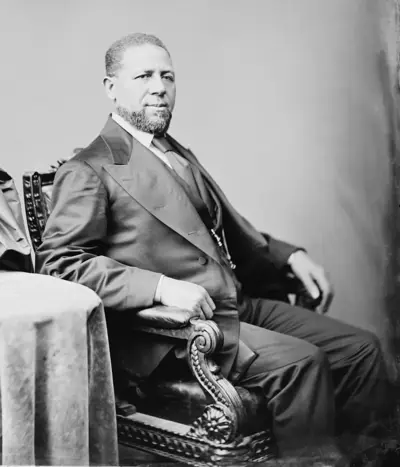
Hiram Rhodes Revels was an American politician, minister in the African Methodist Episcopal Church, and a college administrator. Born free in North Carolina, he later lived and worked in Ohio, where he voted before the Civil War. He became the first African American to serve in the U.S. Congress when he was appointed to the United States Senate as a Republican to represent Mississippi in 1870 and 1871 during the Reconstruction era.
