John Fremont Quotes
I have no room for prisoners.
The prisoners were shot. Over a decade later, Fremont was running for the Presidency against Buchanan. This incident became public and hurt Fremont with many voters.
John Fremont, 1813-1890, Explorer, General, and Republican Candidate for President, Statement to his chief scout, Kit Carson, who informed Fremont that they had captured some prisoners during the Mexican War
Sourced by: Eigen's Political and Historical Quotations

Enemy captives were sometimes adopted by Indian families to replace a lost loved one.

The Abenaki Indians from Canada had come South and raided many of the settlements of upstate New York. In the process, they committed many atrocities killing civilian men, women and children. Amhurst ordered Robert Rogers and his rangers to attack the Abenaki home villiage in Canada on a famous punitive raid. The Rangers, did indeed, raid the Abenaki and wiped out all the males of the tribe that were in the camp at the time. Amhurst hated Indians, but still had his standards regarding the killing of women and children, but was perfectly willing to kill all the mature males. There were no Geneva Conventions at the time. The same general introduced biological warfare by giving Indians smallpox infected blankets. See {619646}

1000 Spanish prisoners of war were over a 4 day period beheaded. This infamous order has been a black mark on his general democratic and humane public life. Some apologists for his war crimes point out that the Spaniards were making an all-out assault on his revolutionary troops who were very badly outnumbered. It took many revolutionary solders to guard the prisoners and if Bolivar lost the upcoming battle, it would have been the end of his revolution and Spain might still be in control of much of South America. With the additional soldiers freed up from guard duty, Bolivar barely survived the battle and the Revolution was not crushed.

About 2000 Irish were slaughtered while Cromwell only lost 64. In the Irish Rebellion of 1641, many English Protestants—men, women and even children were massacred by Catholic rebels who were out of control of their leadership. See {639336} for an example. Cromwell, when he landed in Ireland with his troops, made no bones about the fact that he was there to avenge the massacres of 1641 {639283} . This was his first “payback”. 150 years later the Irish Protestants memorialize the massacres of the Rebellion of 1641. The Catholics, memorialize, the massacre at Drogheda. Each group uses these and other similar events to justify their positions of antagonism against the other. See {639282} for a moral analysis of Cromwell’s action here.


Clark’s men had English Colonel Hamilton under siege by making him think there were many more Americans in Clarks army than the real 180 or so. He tried to get Hamilton to surrender by threatening if they had to take the fort they would treat Hamilton and the British as murderers—Hamilton had paid hostile Indians for American scalps. At that point a party of Clark’s men arrived with 4 or 5 Indian prisoners who had been captured raiding
civilian farms. After the Indians were executed, Hamilton agreed to surrender.

The British Governor was genuinely anxious to avoid bloodshed and the American Revolution. However, the conflict had been brought about by the actions of the British Parliament and the Kings ministers, and Gage did not have the power or authority to alter the issues of the fundamental conflict—taxation, colonial government, economics, self determination. While he offered pardons, in this proclamation he specifically exempted Samuel Adams and John Hancock of whom he said “whose offences are of too flagitious a nature …”

The Colonel defined people capable of bearing arms as males and females over 20 years of age. Many were slaughtered. Fortunately, most of his officers and men did not follow this order but enough did to make it one of the most disgraceful events in American military history. Smith was court marshaled and found guilty but his punishment was to be cashiered from the army. There were many atrocities committed by the minorities of both sides in this brutal war. Military and Congressional Investigations caused the army manual to be revised military policies reformed.
The Philippine-American War was terribly brutal. In response to insurgent atrocities against American soldiers, some of the Americans also adopted brutal tactics including torture and mutilation. Washington had heard stories of this improper behavior in the part of some American troops and instructed the senior officers to investigate and discipline the men if the reports were true. Unfortunately some of the senior officers covered up the illegal and criminal behavior of some Americans. This quotation was taken from a New York Times report on a representative of the Red Cross who went to the Philippines at the invitation of the insurgents. He generally found serious atrocities by some of the soldiers on both sides but by no means all of the combatants. General Otis, the U. S. Commander tried to keep Blake out, and had him detained away from the battle areas for some weeks where he was “educated” about the enemy atrocities. Finally Blake got to the field and reached the insurgent commander who had invited him. His report generally praised the American troops, but spared no details when there were guilty of atrocities.

The Vice President’s Chief of Staff, Scooter Libby, had committed criminal acts in his zeal to threaten an experienced American Diplomat who had gone on an assignment for the CIA and reported information that cast doubt on the story that the Iraqis were about to deploy a nuclear weapon, thus giving ammunition to the few people in Washington who did not want to invade Iraq. To hurt the Ambassador, Libby leaked the fact to the press that his wife was a covert CIA agent. This not only ruined her career as she had been outed, a crime, but she was one of the CIA’s most effective agents whose contacts abroad were then put in terrible danger as having been working with a spy. No one at the time knew who the leaker was, but Bush was furious—see {630116}. He ordered all White House staff to find the leaker. The Vice President and Libby did not tell the President who the leaker was thinking that no one would ever find out. But when it was discovered it was public and Libby was indicted and faced trial. In the last days of Bush’s presidency Vice President Cheney put tremendous pressure on the President to Pardon Libby as did the extreme right wing of the Party. Cheney accused Bush of “leaving wounded on the battlefield’ arguing that Libby did everything for the President and his decision to invade Iraq. Bush had no formal policies and rules about pardons that he could turn to or ask a staffer to determine if the case warranted it. He finally yielded and commuted Libby’s prison sentence but left intact the $240,000 fine, the community service and the conviction of a felony which caused Libby to lose his license to practice law. Given Bush’s angry statements about the leak before the leaker was determined, he was accused of being a partisan hypocrite, uncaring about our agents safety and national security when his associates were guilty. The VP and the Republican extremists were also angry that Bush did not Pardon Libby completely and left the felony conviction on his record. This plagued Bush in the latter days of his presidency where his popularity had sunk very low. He wanted to help the new President avoid the same mistake. Ironically Clinton did not take his advice to have a firm pardon policy and in the closing days of the Clinton administration where he was very popular despite the partisan accusations and attempts to impeach him, ended up under great pressure for pardon’s and made some that have tarnished his reputation ever since.

Lawrence of Arabia. In the Middle East, Lawrence led a small Arab army against the Turks and the Germans. In a battle near Tafas, the captured 250 Turkish and German soldiers as prisoners. They them shot them all in cold blood with their Hotchkiss machine gun. What makes this quotation so significant is that one of the great British heroes of WWI was actually guilty of War Crimes. An American journalist gave Lawrence and his exploits great publicity without mentioning the atrocities. The British chain of command also ignored the transgression of one of the most fundamental rules of war even though the clear evidence was in basic battle report files. However, the British never removed the report from the files or destroyed it. The Turks and the Germans while they respected the rules of war with the English, French, and most allies, treated the Arabs much more harshly and murdered Arab prisoners on many occasions. In part this atrocity at Tafas was an act of vengeance and retaliation. But Lawrence never even tried to explain it.


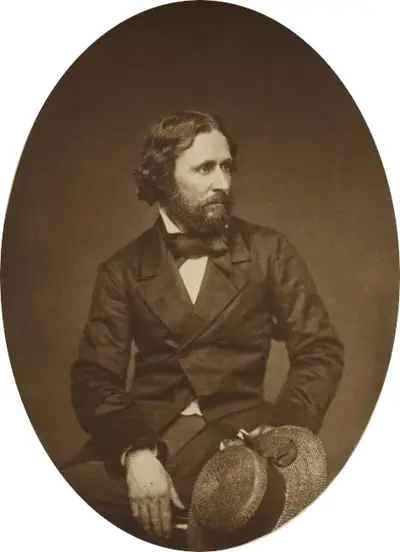
John Charles Frémont or Fremont was an explorer of the Western United States, military officer, and politician. He was a U.S. Senator from California, and in 1856 was the first Republican nominee for President of the United States. A native of Georgia, he was an opponent of slavery but also a contributor to Native American genocide.
