Murray Kempton Quotes
I have always found Franklin Delano Roosevelt an amusing fellow, but I would not employ him, except for reasons of personal friendships, as a geek in a common carnival.
FDR was terribly affable and was at the opposite end of the spectrum from the ideologues. Therefore he never offered specific programs. He was this grossly underestimated by many of the pundits of the day as being shallow with few or no ideas. Actually, he implemented more new ideas and programs than any other President in history but was very pragmatic about them and not really wedded to any of them. If one thing did not work, he tried another. The people and the Congress grew to trust him as no other president in our history although he always had his right wing enemies.
Murray Kempton, 1917-1997, Journalist & Commentator, Quoted in McPhee, The Book of Insults, 1978
Sourced by: Eigen's Political and Historical Quotations


Coughlin was an early and valued supporter of FDR, but after Roosevelt’s election the priest became dissatisfied that Roosevelt was not radical enough. FDR also wanted to distance himself from many of the Fascist and Socialist ideas of Coughlin and especially his racism and anti-Semitism. Coughlin then flip-flopped and became a vicious Roosevelt Critic. Few realize that he ever supported Roosevelt.

Hoover, a brilliant administrator before his presidency, was so ideological about the role of government that when the Great Depression came, he was unwilling to use government directly to cope with the new problems. He was turned out of office in favor of FDR and the New Deal which the voters ratified 4 times. Hoover was embarrassed by the New Deal successes and lashed out with many insults. In this case, he called the New Deal “fascist”. See {629055} for another quote where he labels the New Deal communistic. Ironically, Hoover is rated by most historians as one of the least effective Presidents in American history while Roosevelt is always rated among the top 3 presidents.

Hope cracked this joke after Franklin Delano Roosevelt was elected for an unprecedented fourth term as president:


This was the statement that caused many senators to block her appointment as a Federal judge.

Browder, had been prohibited by Court Order from touring the country during the 1940 Presidential Campaign. He personally blamed FDR although the Communist vote was so small that no matter where and how Browder campaigned it would not have made any difference. However, the court order gave Browder the opening leading some to believe that the communist following was larger than it was—why else would the establishment want to keep the campaign limited?

Kennedy hated Roosevelt who had forced him to resign as the U. S. Ambassador to England. Kennedy was an admirer of Mussolini and Hitler. He had allied himself with the part of the British aristocracy that was pro Fascist and opposed Winston Churchill and the democratic element in Britain. Kennedy had opposed aid to Britain to fight Hitler and advised all who would listen that Britain could and would not stand up to Germany. Roosevelt’s support of Britain with Lend Lease and other means proved Kennedy wrong pragmatically and Kennedy’s own statements had forever proved him wrong morally. Although Kennedy opposed our entry in WWII, his sons did not. His oldest son volunteered for a very dangerous mission and was killed. Kennedy blamed his death on Roosevelt {616651} and forever after slandered FDR whenever he got a chance until his son Jack got into politics when his ambition for his son outweighed his hatred.

After JFK’s assassination, many of his appointees who were liberal Democrats, were concerned that LBJ was a Southern conservative and might not want to serve in a conservative administration. Johnson satisfied Heller and all of the other Kennedy appointees who he asked to stay on. Actually, Johnson was more liberal than JFK, and proved it during his Presidency.
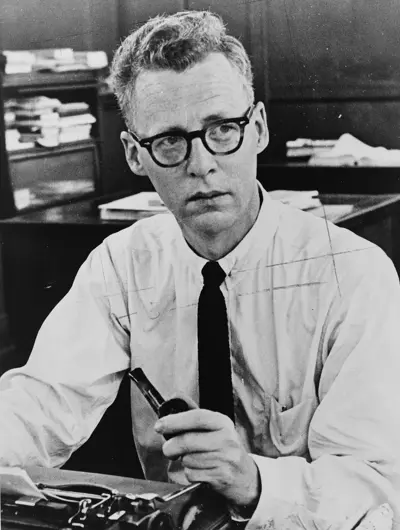
James Murray Kempton was an American journalist and social and political commentator. He won a National Book Award in 1974 (category, "Contemporary Affairs") for The Briar Patch: The People of the State of New York versus Lumumba Shakur, et al. Reprinted, 1997, with new subtitle The Trial of the Panther 21. He won a Pulitzer Prize (category, "Commentary") in 1985 "for witty and insightful reflection on public issues in 1984 and throughout a distinguished career."
