Lyndon B. Johnson Quotes
I am a Roosevelt New Dealer … John F. Kennedy was a little too conservative for me.
Lyndon Baines Johnson, 1908-1973, 36th President of the United States (Democrat, TX), Statement to Walter Heller, Chairman of the Council of Economic Advisors, November 23, 1963
Sourced by: Eigen's Political and Historical Quotations

After JFK’s assassination, many of his appointees who were liberal Democrats, were concerned that LBJ was a Southern conservative and might not want to serve in a conservative administration. Johnson satisfied Heller and all of the other Kennedy appointees who he asked to stay on. Actually, Johnson was more liberal than JFK, and proved it during his Presidency.


Roosevelt’s New Deal would have been impossible without the support of the Southern segregationists.
At that time, all the racist segregationists of the South were Democrats, unlike in the latter part of the 20th century where, after the Democratic President Lyndon Johnson, pushed through the Civil Rights Act, the segregationists accepted an invitation to switch to the Republican Party. In the 1930s, FDR’s Congressional majority depended on these segregationists. This is why, even though the New Deal liberalized most of American life, FDR did very little about racial equality and Civil Rights. In the 21st century, Republican Administrations could not do much about the remaining equality and civil rights issues. The racists of America, although far fewer in number, voted for the Republicans and were an important part of their base, just as they had been for FDR during the New Deal.

Coughlin was an early and valued supporter of FDR, but after Roosevelt’s election the priest became dissatisfied that Roosevelt was not radical enough. FDR also wanted to distance himself from many of the Fascist and Socialist ideas of Coughlin and especially his racism and anti-Semitism. Coughlin then flip-flopped and became a vicious Roosevelt Critic. Few realize that he ever supported Roosevelt.

FDR was terribly affable and was at the opposite end of the spectrum from the ideologues. Therefore he never offered specific programs. He was this grossly underestimated by many of the pundits of the day as being shallow with few or no ideas. Actually, he implemented more new ideas and programs than any other President in history but was very pragmatic about them and not really wedded to any of them. If one thing did not work, he tried another. The people and the Congress grew to trust him as no other president in our history although he always had his right wing enemies.


One-liner, soundbytes, have been good political oratory long before TV


Ford was outraged about the President’s administration making rules and regulations to cope with the worst economic crash in American History. Former President Hoover had been voted out of office because philosophically he believed like Ford that the Federal Government should not be actively involved with private business and the economy. Some view regulation as meddling and interference while others see it as fulfilling its responsibility for the majority of citizens. See {642381} for Ford’s view of the Great Depression.


Hoover, a brilliant administrator before his presidency, was so ideological about the role of government that when the Great Depression came, he was unwilling to use government directly to cope with the new problems. He was turned out of office in favor of FDR and the New Deal which the voters ratified 4 times. Hoover was embarrassed by the New Deal successes and lashed out with many insults. In this case, he called the New Deal “fascist”. See {589568} for another quote where he labels the New Deal communistic. Ironically, Hoover is rated by most historians as one of the least effective Presidents in American history while Roosevelt is always rated among the top 3 presidents.

Kennedy hated Roosevelt who had forced him to resign as the U. S. Ambassador to England. Kennedy was an admirer of Mussolini and Hitler. He had allied himself with the part of the British aristocracy that was pro Fascist and opposed Winston Churchill and the democratic element in Britain. Kennedy had opposed aid to Britain to fight Hitler and advised all who would listen that Britain could and would not stand up to Germany. Roosevelt’s support of Britain with Lend Lease and other means proved Kennedy wrong pragmatically and Kennedy’s own statements had forever proved him wrong morally. Although Kennedy opposed our entry in WWII, his sons did not. His oldest son volunteered for a very dangerous mission and was killed. Kennedy blamed his death on Roosevelt {616651} and forever after slandered FDR whenever he got a chance until his son Jack got into politics when his ambition for his son outweighed his hatred.


The Ambassador was not on the best terms with FDR. He met with the Luces, key Republicans on Wendell Willkie's team regarding his delivery of the Catholic vote.

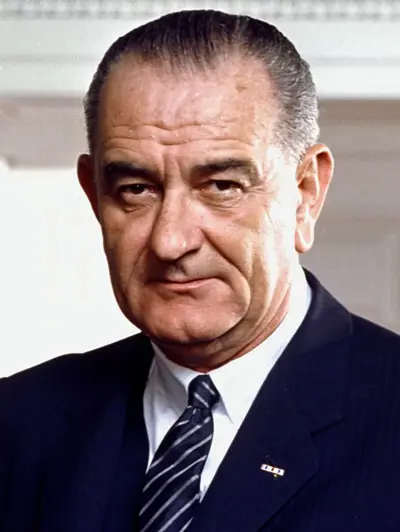
Lyndon Baines Johnson, often referred to by his initials LBJ, was the 36th president of the United States, in office from 1963 to 1969. He served as the 37th vice president from 1961 to 1963 and assumed the presidency following the assassination of President John F. Kennedy. A Democrat from Texas, Johnson was also a United States representative and later majority leader in the United States Senate. Johnson is one of only four people to have served, at various times, in all four federal elected positions.
