Winston Churchill Quotes
Meeting Franklin Delano Roosevelt for the first time was like having your first bottle of Champaign.
Winston Churchill, 1874-1965, British Prime Minister (Conservative), Quoted in PBS, The Charlie Rose Show, July 11, 2013
Sourced by: Eigen's Political and Historical Quotations


FDR was terribly affable and was at the opposite end of the spectrum from the ideologues. Therefore he never offered specific programs. He was this grossly underestimated by many of the pundits of the day as being shallow with few or no ideas. Actually, he implemented more new ideas and programs than any other President in history but was very pragmatic about them and not really wedded to any of them. If one thing did not work, he tried another. The people and the Congress grew to trust him as no other president in our history although he always had his right wing enemies.


Lindbergh, a great aviator, was a Fascist who was a great admirer and supporter of Hitler and Mussolini. By this time, even Lindbergh had seen much of the German aggression, and his opposition to the war was on the pragmatic ground that we could not win. He thought that democracy was too unsuited to a country being a major power.


Ford was outraged about the President’s administration making rules and regulations to cope with the worst economic crash in American History. Former President Hoover had been voted out of office because philosophically he believed like Ford that the Federal Government should not be actively involved with private business and the economy. Some view regulation as meddling and interference while others see it as fulfilling its responsibility for the majority of citizens. See {642381} for Ford’s view of the Great Depression.
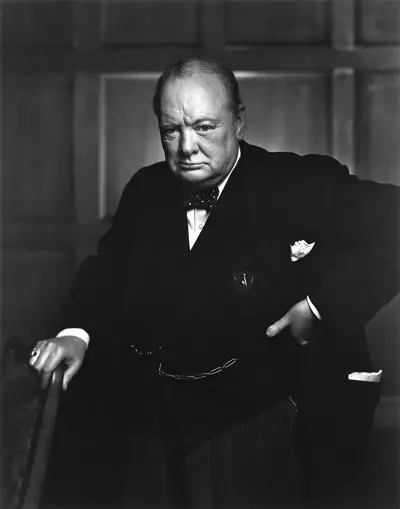
Sir Winston Leonard Spencer Churchill, KG, OM, CH, TD, DL, FRS, RA was the Prime Minister of the United Kingdom from 1940 to 1945, during the Second World War, and again from 1951 to 1955. Apart from two years between 1922 and 1924, Churchill was a Member of Parliament (MP) from 1900 to 1964 and represented a total of five constituencies. Ideologically an economic liberal and imperialist, he was for most of his career a member of the Conservative Party, as leader from 1940 to 1955. He was a member of the Liberal Party from 1904 to 1924. Churchill was also well known for his military career and as a historian, painter and writer, and among his many awards was the Nobel Prize in Literature.
