John Kenneth Galbraith Quotes
[Franklin Delano] Roosevelt was the central world figure in the two great disasters of this century - the Great Depression and World War II. By contrast, JFK came in relatively peaceful, agreeable times.
Galbraith, John Kenneth. A Life in Our Times: Memoirs. Houghton Mifflin, 1981.


Germany had some world class physicists. Our scientists, military intelligence people, and political leadership assumed that the Germans were also seeking to develop the Atomic Bomb. Ironically, it turned out that they were not, and what Truman reported in this quotation was untrue (although that was not fully known at the time.) Einstein and several of the scientists who were early pioneers in modern physics were Jewish, and Hitler referred to the study of nuclear fission and fusion as “Jewish Science.” As a result, the German government did not commit the resources to the development of an atomic bomb. Instead, they were betting on the development of the Jet Airplane which they succeeded in deploying against the Allies at the end of the war. But they did not have enough or enough pilots left alive to fly them, and Germany was overrun by the Allied Troops. Prior to Truman’s erroneous report about the German development of an atomic bomb, there had only been one piece of evidence that the Germans were not developing one. An OSS secret agent, Moe Berg, had talked with Werner Heisenberg, at a Swiss scientific conference during the war. He was going to assassinate the greatest of the German physicists if Berg thought he was working on a nuclear device. Berg concluded from his discussions that Heisenberg did not know enough about nuclear fission to have been working on that. Berg did not kill Heisenberg, and reported that he did not think the Germans were developing a bomb as if they were Heisenberg would have been deeply involved. However, the American intelligence people and the American scientists, did not trust Berg’s analysis and conclusion. Berg was not a trained scientist. He was a professional baseball player—the NY Yankee backup catcher to Bill Dickey. He was a college graduate, a brilliant guy and a very fast learner who had studied physics books and papers before his assignment. Berg turned out to have been right, but that was not confirmed until a few years after the war. Truman had relied on an incorrect intelligence estimate when he made this quotation. It was not the first such error of intelligence analysis in American history and it would not be the last.


The normally highly individualistic scientists from so many different cultures amazed all, especially the military, with the teamwork and organization of their effort. They all wanted to be sure that the Germans would not first develop the bomb and the refugees from Europe shared experiences that motivated them all. Also, the Army was very ham handed in trying to organize a community of scientists, and there was a great deal of cohesion to keep the army out of their day to day affairs. The other major factor was J. Robert Oppenheier, the scientific director, who despite his lack of managerial or leadership experience, rose to the occasion and became one of the great scientific administrators of all time. Ulam with Edward Teller were the first to design the Hydrogen Bomb.

Bethe and other European refugees joined American and British scientists at Los Alamos, NM, for the development of the atomic bomb.

There was a major leak of the administration’s contingency plans for war in Europe. FDR had run on a platform not to send American troops to Europe, and this leak, presented as a fete a compli, caused a political upheaval.


At the time, surprising to most people now, the use of the atomic bomb was not an issue of controversy at all. There were no Congressman who questioned it, no newspapers which editorialized against the use of the bomb. There were not even any other counties which protested its use. The blessing of ending the war, even at the cost of less than 200,000 deaths seemed a clearly desirable tradeoff when compared with the many millions of deaths that would have occurred had the bomb not been used. As an example, the conventional bombing of Tokyo before the nuclear weapons were used killed as many Japanese as either Hiroshima or Nagasaki.

There were some doubts the scientists developed after Germany had surrendered as Hitler had been their greatest fear. So they were briefed on the planned invasion of the Japanese mainland and the military medical preparations for treating and caring for ½ million serious wounded casualties. In addition, given the state of war, there was expected about the same number of American Military deaths. On top of that, there would be many more Japanese military casualties plus even more Japanese civilian deaths and wounded. The use of the Atom Bomb would save all those lives but have casualties of its own, but far fewer. At the time, surprising to most people now, the use of the atomic bomb was not an issue of controversy at all. There were no Congressman who questioned it, no newspapers which editorialized against the use of the bomb. There were not even any other counties which protested its use.


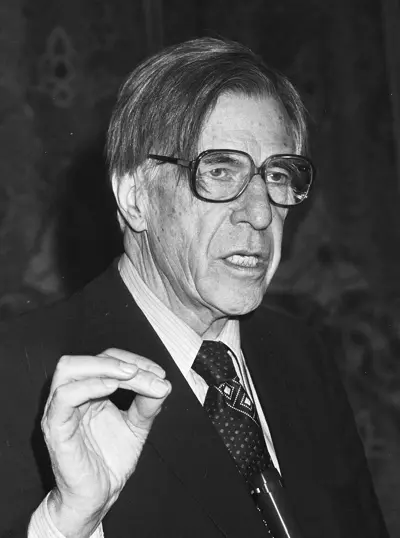
John Kenneth Galbraith OC, also known as Ken Galbraith, was a Canadian-American economist, diplomat, public official and intellectual. A leading proponent of 20th-century American liberalism, his books on economic topics were bestsellers from the 1950s through the 2000s. As an economist, he leaned toward post-Keynesian economics from an institutionalist perspective.
