William James Quotes
I had two days spoiled by a psychological experiment with mescal, an intoxicant used by some of our Southwestern Indians in their religious ceremonies; a sort of cactus bud, of which the U.S. Government had distributed a supply to certain medical men, including Weir Mitchell, who sent me some to try. He had himself been 'in fairyland.' It gives the most glorious visions of color--every object thought of appears in a jeweled splendor unknown to the natural world. It disturbs the stomach somewhat, but that, according to W. M., was a cheap price. I took one bud three days ago, was violently sick for twenty-four hours, and had no other symptom whatever except that and the Katzenjammer the following day. I will take the visions on trust!
This is an interesting quotation in that we see that the Federal Government actually distributed the hallucinogen, mescaline, to some physicians and psychologists to experiment with. Historically, morphine, cocaine and opium were not only legal at this point but were commonly sold as medicine. President McKinley gave an endorsement for Mariani Wine—Bordeaux wine laced with cocaine. The slogan “Good for what ails you” was used to sell patent medicines, so laced with narcotics that people with almost any ailment would “feel good” for a while and many would refrain from needed medical treatment. It would take over a decade more for policy makers to learn of the addicting properties of narcotics and other drugs as well as their other deleterious properties.
William James, 1842-1910, Psychologist & Philosopher, Letter to Henry James, June 11, 1896
Sourced by: Eigen's Political and Historical Quotations

Watchtower Bible and Tract Society of New York. Alcohol is medically and scientifically a drug and an addicting drug at that. The Jehovah's Witnesses also shun alcohol for that reason.


This quotation brought him much ridicule. See {585947}. Clinton was of the swing era where there were very negative public views about the morality of using illicit drugs and the character of those who might have used it. So Clinton felt constrained to emphasize that it was only marijuana, the most popular and benign of the illicit drugs, and to emphasize the fact that he did not enjoy it. His successor, however George W. Bush, had been an alcoholic and a heavy cocaine user, but learning from the Clinton error, would never comment about it other than to say that it was wrong and he urged all to avoid drugs.

The cocoa plant produces leaves which the Bolivian Indians have been chewing for centuries as mild stimulant and assuager of hunger pangs. However with Western chemistry, the cocoa leaves can be turned into cocaine. The Cocoa crop has a ready market domestically and a hugely inflated profit for exports to the illicit drug trade. The United States has put pressure on Bolivian politicians to make growing of the cocoa plant illegal, and has supplied the chemicals and the funds to destroy the cocoa crop wherever they find it growing. This angers small peasant farmers for whom this is the most profitable crop and one of the few on which they can even grow in much of the country; it also angers the vast majority of the Indian population—about half the country—as they are pressured to give up chewing cocoa. The Indians have virtually no harmful effect from chewing cocoa leaves and say that the problem is with the Gringos who are drug users and cannot control themselves. Why should they give up their preferences, traditions and customs because the North Americans are irresponsible and cannot control themselves? Chavez, the first ethnic Indian President of Bolivia took the position that the peasants and peasant farmers should not have to sacrifice to benefit the rich Americans and others in the world. America has a prevention and education problem and Americans should stop buying the cocaine—a product on which the Bolivian Indians make almost nothing; they would be happy just growing leaves for the domestic market.

Leary was a strong advocate of the use of illicit drugs and stimulants. Yet he ignored all the side effects and negative health consequences of the processes and while he thought he was assisting people to enlarge their mental horizons, he irresponsibly and criminally damaged many permanently. His government “persecutors” themselves were also all disgraced by the extremes to which they went to prevent the counter-culture characterized by Leary and others. They became paramoid that the drug culture would morph into a protest culture against the administration. The tended to exxagerate the negative consequences of illicit drugs--especially marijuana. These exaggerations caused many people to believe Leary and others who went to the other extreme and underated the negative consequences of illicit drugs. It became a culture war when it should have been a medical problem.


Central Intelligence Agency. The MKULTRA scandal involved testing LSD on unwitting American subjects. Under the influence of the powerful drug people did all kinds of unwholesome and illegal things with the CIA agents observing and in some cases participating. Several American citizens suffered permanent damage.

He was the first Chinese official to make opium illegal. However, British many merchants were involved in a complicated trade scheme whereby they brought opium to Canton. They paid not attention to the new laws against opium the same as their Chinese customers. Lin Zexu, perceiving Queen Victoria to have powers equivalent to the Chinese Emperor who could do anything in China, He assumed that the Queen could and would control the merchant’s behavior, and before punishing the British merchants, he was putting the Queen on notice. There is no record of what Victoria did, if anything. When Lin Zexu tried to enforce his ban on opium, the British Merchants resisted and the First Opium War broke out between China and Britainin which the Chinese were humiliated and resent to this day. A bronze statue of Lin Zexu was erected in his honor in Chatham Square (Kimlau Square) of New York City's Chinatown.

He was opposed to the use of illicit drugs when most writers claimed that drug taking opened new vistas. Koestler, a Hungarian Jew, lived and worked in England for most of his life. He was not only a great writer, but was an amateur scientist.


Marijuana was and still is a health and social problem in that people who tend to use it---especially young people---tend not to focus on their friendships, their work and study obligations, their own development and welfare. However it is nowhere near the degree of deleterious problems of alcohol and other drugs like heroin, cocaine, and methamphetamine. There is no record of anyone dying from an over dose or marijuana while alcohol and other drugs kill hundreds if not thousands a year. But none of those health emergencies compare with the flu which each year kills over 20,000 Americans who do not get inoculations or highway crashes which kill about 50,000. Yet Nixon did not characterize these as “national emergencies.”

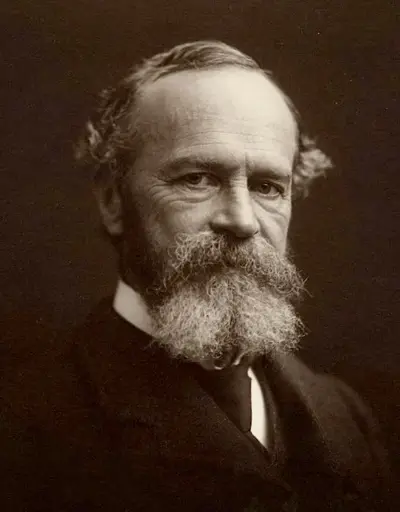
William James was an American philosopher, historian, and psychologist, and the first educator to offer a psychology course in the United States. James is considered to be a leading thinker of the late nineteenth century, one of the most influential philosophers of the United States, and the "Father of American psychology".
