Dwight D. Eisenhower Quotes
I had been conscious a feeling of depression and so I voiced to [Secretary Of War Stimson] my grave misgivings, first on the basis of my belief that Japan was already defeated and that dropping the bomb was completely unnecessary, and secondly because I thought that our country should avoid shocking world opinion by the use of a weapon whose employment was, I thought, no longer mandatory as a measure to save American lives. It was my belief that Japan was, at this very moment, seeking a way to surrender with a minimum loss of 'face.'
Eisenhower, Dwight D. The White House Years: Mandate for Change, 1953-1956. Doubleday, 1963, p. 312.


At the time, surprising to most people now, the use of the atomic bomb was not an issue of controversy at all. There were no Congressman who questioned it, no newspapers which editorialized against the use of the bomb. There were not even any other counties which protested its use. The blessing of ending the war, even at the cost of less than 200,000 deaths seemed a clearly desirable tradeoff when compared with the many millions of deaths that would have occurred had the bomb not been used. As an example, the conventional bombing of Tokyo before the nuclear weapons were used killed as many Japanese as either Hiroshima or Nagasaki.

When the doubts began to be expressed, the scientists were briefed on the planned invasion of the Japanese mainland and the military medical preparations for treating and caring for ½ million serious wounded casualties. In addition, given the state of war, there was expected about the same number of American Military deaths. On top of that, there would be many more Japanese military casualties plus even more Japanese civilian deaths and wounded. The use of the Atom Bomb would save all those lives but have casualties of its own, but far fewer. At the time, surprising to most people now, the use of the atomic bomb was not an issue of controversy at all. There were no Congressman who questioned it, no newspapers which editorialized against the use of the bomb. There were not even any other counties which protested its use.


At that time there were extensive meetings and discussions for the creation of what was to be the United Nations. The negative view of the United Nations or other international security organization is now and always has been held by a vocal minority in the United States.

On March 9-10, 1945, over three hundred B-29 Superfortresses loaded with 2,000 tons of incendiary bombs flew over Tokyo bombing the city in waves for 6 hours. Over 250,000 buildings were destroyed and more people were killed than would be in either Hiroshima or Nagasaki which were destroyed by atomic bombs. See {615730} and {615733}. The technique called area bombing was then implemented on Japanese cities 66 more times. Stimson was seriously worried that there would be no large targets in Japan left on which the dramatic effect of the atomic bomb could be demonstrated. And without such a demonstration, there would not be a likely Japanese surrender as all the devastating conventional bombing had not persuaded the Japanese. A land invasion with perhaps millions of casualties might be required.

Although generally a right wing conservative, Clark today sounds like almost like an extreme leftist on the issue. At the time however, many thought that he had taken leave of his senses. He not only was completely contrary to bipartisan national policy but opposed by almost universal American public opinion. He is one of the very few significant American officials to oppose the war policies.

Truman had just told Stalin about the new technology. Stalin had actually already known something about it as the result of Soviet espionage in the United States.


The term “your” referred to the imperialists in America who were supporters of the war in the Philippines. There were some unfortunate atrocities committed by American officers. See General Jacob H. Smith: {42097}.

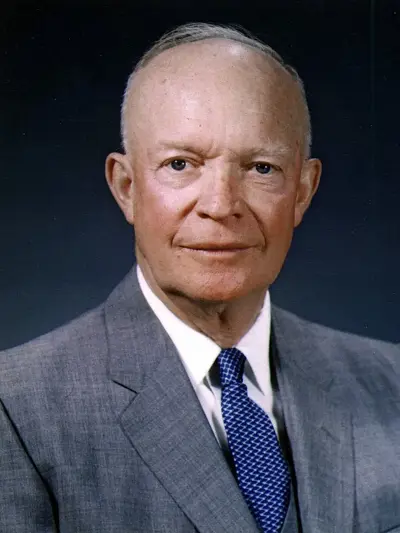
Dwight David "Ike" Eisenhower GCB OM GCS CCLH KC NPk was an American military officer and statesman who served as the 34th president of the United States from 1953 to 1961. During World War II, he became a five-star general in the Army and served as Supreme Commander of the Allied Expeditionary Force in Europe. He was responsible for planning and supervising the invasion of North Africa in Operation Torch in 1942–43 and the successful invasion of Normandy in 1944–45 from the Western Front.
