Bill Clinton Quotes
I don’t care how precise your bombs and weapons of war are. When you set them off, innocent people will die.
William Clinton, 42nd President of the United States (Democrat, AR), Speech, British Labour Party Conference, Blackpool England, October 2, 2002
Sourced by: Eigen's Political and Historical Quotations

Bombing had reached the point where conventional bombing raids on industrial cities like Tokyo and Hamburg produced even more civilian casualties than did the atomic bomb at Hiroshima. Tibbets’ view, through the lens of hindsight, was developed by many of the Allied servicemen who had been forced into war by expansionist and militaristic nations like Japan and Germany both of which placed much of their war material manufacturing capability in the midst of their otherwise civilian cities. Both brutally violated the laws of war and committed atrocities many times over before the allies began retaliating. There are still some who believe that it was wrong to drop the atomic bomb on Japan. Some even feel that the mass bombing of Japanese and German cities in retaliation and in furtherance of the war effort was morally wrong. But at the time, the millions of casualties anticipated in the invasion of the Japanese mainland, persuaded virtually every American soldier and civilian that there was nothing wrong with use of the Atomic bomb, and many saw it as an absolute Godsend to prevent all the American and Japanese causalities that would have come otherwise. Many scholars remark on how it was virtually impossible to find any significant number of misgivings before or just after Hiroshima. Tibbet’s view was typical.


Mahathir, in his moral assessment, fails to come to grips with the fact that the Coalition forces in their Afghan and Iraq activities attempt to kill and injure as few people as possible to accomplish their objective. The terrorists attempt to kill and injure as many people as possible. In the September 11 attack, the buildings could have been attacked late at night so there would be few casualties, and in Bali they could have bombed the facility after it had closed instead of waiting until there was the largest audience. And the terrorist bombs include nails, rat poison, and other additional material designed not to do more building damage, but to kill and maim more people which is their specific objective. Most wars have collateral damage and the parties are required to make a good faith attempt to minimize that. But the terrorists not only make no attempt, but make strong efforts to kill as many as possible. That is a huge moral and ethical distinction.


Ironically, one of the major objections to drone strikes is that they have caused civilian casualties.


Although the Amerian Drone program did inadvertently kill untargeted or mistakenly targeted civilians at that time, the collateral damage rate was smaller than any other weapons system available to the American forces. War has always produced unintended collateral damage. The only way to stop the killing of innocent civilians then and now is to stop the war.

Hamas had fired thousands of rockets and other missiles at Israeli population centers—war crimes under the Geneva Conventions. Israel finally retaliated against Hamas facilities in Gaza. However, in an unprecedented effort to avoid civilian casualties, the Israeli Defense Forces warned the people by indicating which targets they were going to strike. They also dropped leaflets in Arabic telling the civilians that they are not the targets but to try and avoid harm to them and their families, they should evacuate the neighborhoods that would be under attack. Hamas had placed their missile launchers and other weapons in and near schools, hospitals, mosques and civilian housing risking their civilian population—see {640841}.
There was extensive hostility expressed by civilian populations in Pakistan and other countries where the United States made Drone strikes to take out terrorist leaders. However, there was much anti-American feeling in Pakistan before the Drone strikes.


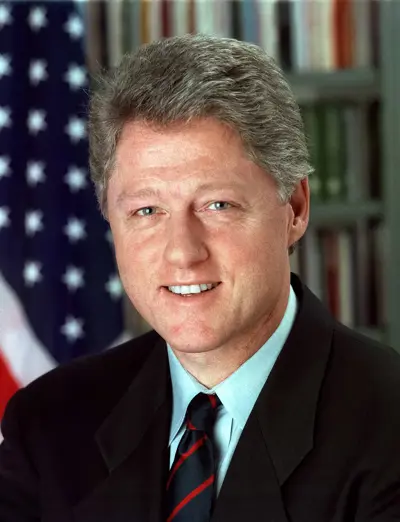
William Jefferson "Bill" Clinton is an American politician who was the 42nd President of the United States from 1993 to 2001. Clinton was previously Governor of Arkansas from 1979 to 1981 and 1983 to 1992, and the Arkansas Attorney General from 1977 to 1979. Clinton was born William Jefferson Blythe III – he changed to his stepfather's name at age 15.
