Tawakkol Karman Quotes
I discovered that wearing the veil is not suitable for a woman who wants to work in activism and the public domain. People need to see you, to associate and relate to you. It is not stated in my religion to wear the veil; it is a traditional practice, so I took it off.
Al-Sakkaf, Nadia. "Renowned Activist and Press Freedom Advocate Tawakul Karman to the Yemen Times: 'A Day Will Come When All Human Rights Violators Pay for What They Did to Yemen.'" Yemen Times, 17 June 2010.


He is often referred to as The Reformer as he was a modernist. In particular, the told his people that there was no religious obligation is Islam for wearing a veil or a burka. These are just customs. Yet most Muslims still believe that veils and burkas were required by God. The only Koranic statement on the subject simply says that women should dress modestly. Despite his efforts, veils and burkas are still required by most Afghani families and most people think the requirement is religious.


Jinnah was a modern Islamist who saw the role of females in a modern context. He, like the Indian Hindu leaders were in a sense products of the West and Western government and education. He would be very surprised that in his Pakistan men can murder their female relatives who they believe have dishonored the family, or that women would not be educated in the Madrassas, or that authorities could sentence a female relative of a man deemed guilty of seduction to be gang raped, but that is what happens in modern Pakistan. Jinnah and many of the early leaders believed that their new government could modernize Islam but the control and influence went the other way. Pakistan became a religiously dominated autocracy rather than the democracy that Jinnah foresaw.


The Kotel -- or the "Western Wall" or the "Wailing Wall" as most outside of Israel call it -- is the Holiest of Jewish places where many Jews gather and pray. But the Ultra-Orthodox Rabbis who were charged by the Israeli Government to manage the Wailing Wall and vicinity had refused to allow women to pray at the wall. After much litigation, the Israeli Supreme Court ruled that women had a right to pray there or anywhere else. After much foot-dragging, a small out of the way area at the wall was designated for women, but many Jews wanted to pray as a family which also offended those Rabbis in control of the area, After more Supreme Court Litigation the Government was ordered to establish an area at the Wall that was open to all. The Israeli Government Ministerial Committee for Holy Places was charged with implementing the Supreme Court rulings. However, Regev--who had ambitions of running for Prime Minister, was a conservative whose political base included the Ultra-Orthodox. When they objected to the Supreme Court Ruling, she resigned from the Commission she chaired rather than implement the law of the land. Her official view on the dire consequences of women (or mixed gender) praying at the Wall brought her the support of her base and the strong opposition of most Israeli women and many men as well.


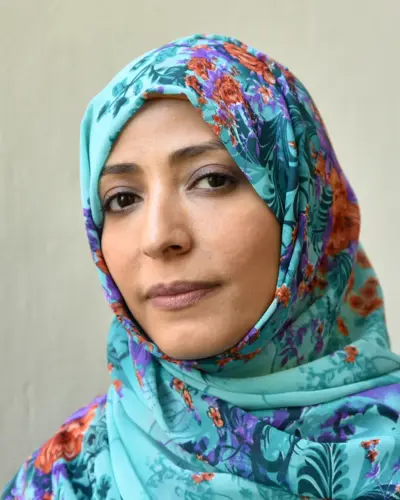
Tawakkol Abdel-Salam Khalid Karman (Arabic: توكل عبد السلام خالد كرمان Tawakkul 'Abd us-Salām Khalid Karmān; also romanized Tawakul, Tawakel) is a Yemeni Nobel Laureate, journalist, politician, and human rights activist. She leads the group "Women Journalists Without Chains," which she co-founded in 2005. She became the international public face of the 2011 Yemeni uprising that is part of the Arab Spring uprisings. In 2011, she was reportedly called the "Iron Woman" and "Mother of the Revolution" by some Yemenis. She is a co-recipient of the 2011 Nobel Peace Prize, becoming the first Yemeni, the first Arab woman, and the second Muslim woman to win a Nobel Prize.
