Anne Hutchinson Quotes
I desire to know wherefore why I am banished.
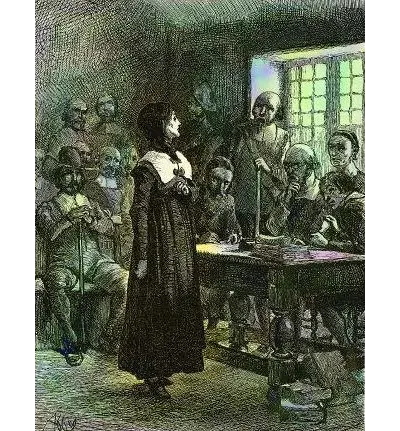
She was tried by the Puritan religious and civil court for heresy. She started with Bible Study classes in her home and drew a substantial following. The clergy at the time were threatened and outraged. It was one thing for a woman to teach Bible Study to other women, but to also have men with the women was too much. The decision of the court was that she was banished from the colony. John Winthrop, Governor of the Massachusetts Bay Colony, presiding, answered: "Say no more. The Court knows wherefore, and is satisfied." See {584754}. In 1987, Massachusetts Governor Michael Dukakis pardoned Anne Hutchinson, revoking the order of banishment by Governor Winthrop 350 years earlier.
Anne Hutchinson, 1591-1643, American Religious Leader & Feminist, Statement to the Court of the Massachusetts Bay Colony, 1638
Sourced by: Eigen's Political and Historical Quotations

Anne Hutchinson was tried by the Puritan religious and civil court for heresy. She started with Bible Study classes in her home and drew a substantial following. The clergy at the time were threatened and outraged. It was one thing for a woman to teach Bible Study to other women, but to also have men with the women was too much. The decision of the court was that she was banished from the colony. See {584753}.

She had been accused of having religious meetings and “instructing” men and women.


He was persecuted by the Roman Catholic Church for figuring out that the earth revolved around the sun which was contrary to church teaching at the time.

Note the opposition to freedom of speech for contrary theological views. This has been typical of most religions whenever they could exercise or influence state power.


- Born: July 17, 1591
- Died: August 27, 1643
- Nationality: American
- Profession: Midwife
Anne Hutchinson was a Puritan spiritual advisor, religious reformer, and an important participant in the Antinomian Controversy which shook the infant Massachusetts Bay Colony from 1636 to 1638. Her strong religious convictions were at odds with the established Puritan clergy in the Boston area and her popularity and charisma helped create a theological schism that threatened to destroy the Puritans' religious community in New England. She was eventually tried and convicted, then banished from the colony with many of her supporters.
