Tariq Ramadan Quotes
I condemn suicide bombings; it’s not acceptable as a Muslim to kill innocent people. It’s explainable. But explainable doesn’t mean justifiable.
Tariq Ramadan, Egyptian Islamic Historian & Political Philosopher, Grandson of Hassan Al-Banna (founder of the Muslim Brotherhood), “Who’s Afraid of Tariq Ramadan?” Foreign Policy, November/December 2004
Sourced by: Eigen's Political and Historical Quotations


A publicity seeking fundamentalist Christian minister in Florida had publicly burned a Koran to the moral condemnation of the President and most other government leaders, as well as clergy of all faiths. However, after the President of Afghanistan condemned the act, there were attacks on a United Nations compound in that country and a number of innocent people were killed and two beheaded. Yet most Muslim clerics were reluctant to morally condemn the murders while they were vociferous in castigating the Koran burning. Some were intimidated and feared that they would be attacked if they criticized the Islamic fundamentalism that advocated the murders and terrorism.

A Fatwa is an Islamic theological legal ruling. Islam has no hierarchy. So this Fatwa is not necessarily binding on any Muslims who do not wish to be bound by it. This is one of the relatively few Islamic theological organizations who have taken a public stand against terrorism.


Many Muslims used passages in the Koran to justify the terrorist attack on New Work and the Pentagon.
Muslim clerics throughout the world had been relatively mild in their criticism of Islamic Extremists and Terrorists. Delic was one of those who urged stronger moral statements. Many of the Muslim clerics in the world actually were themselves holders of Wahhabi and other extremist views. However, many also opposed terrorism and felt that there was nothing in Islam that could justify the indiscriminate killing. However, a number of these were intimidated lest an extremist Muslim cleric issue a Fatwa calling for his death for heresy. Most of us did not then, and even today, do no really understand the extent and frequency of these threats in the Muslim world (and even in the West) and the very frequent assassination or serious wounding of those Muslims who publicly criticize the extremist terrorists. Delic had much more courage than most.

Most Americans and Europeans and their governments feel that Muslim leaders and organizations have not done very much in terms of “drawing the line” and publicly condemning terrorism. However many of the critics did not understand the intimidation that exists in most Islamic communities where the fascist fundamentalists target any Muslim public critics as heretics and apostates themselves. Many have been killed or injured in assassination attempts.


After years of minority Sunni Muslim rule of Iraq, the U. S. invasion gave the majority Shiite Muslims political control. The Sunnis and Shiites have been at each others throats for centuries despite the fact that they are both Muslims. Saudi Arabia is the center of Sunni Islam and many of its religious extremists issue edicts advocating the suicide bombing of Shiite mosques and other facilities and assuring martyrdom for the suicide bombers.


Most Islamic fundamentalists oppose the education of girls. Malala Yousafzai as a teen ager spoke out encouraging girls to go to school. This offended some of the Taliban fundamentalist terrorist, who threatened her if she continued to speak out. When she continued, they tried to murder her. They shot her in the head, but she was airlifted for medical treatment and survived. She was the winner of the European Sakharov Prize for Freedom of Thought and nominated for the Nobel Prize.


The column was written in the immediate aftermath of the terrorist murder of hundreds of school children and adults in Russia. The newspaper was the largest Arab newspaper in the world.


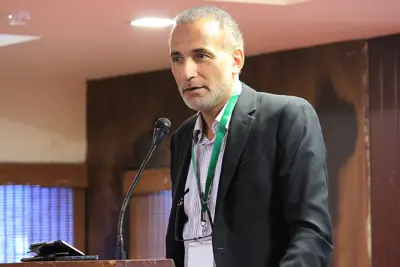
Tariq Ramadan is a Swiss Muslim academic, philosopher, and writer. He was a professor of contemporary Islamic studies at St Antony's College, Oxford and the Faculty of Theology and Religion, University of Oxford, but as of 2018 is taking an agreed leave of absence. He is a visiting professor at the Faculty of Islamic Studies at Hamad Bin Khalifa University in Qatar, and the Université Mundiapolis in Morocco. He is also a senior research fellow at Doshisha University in Japan. He is the director of the Research Centre of Islamic Legislation and Ethics (CILE), based in Doha. He is a member of the UK Foreign Office Advisory Group on Freedom of Religion or Belief. He was elected by Time magazine in 2000 as one of the seven religious innovators of the 21st century and in 2004 as one of the 100 most influential people in the world and by Foreign Policy readers (2005, 2006, 2008–2010, 2012–2015) as one of the top 100 most influential thinkers in the world and Global Thinkers. Ramadan describes himself as a "Salafi reformist".
