Tariq Ramadan Quotes
You are unjustified if you use the Koran to justify murder.
Many Muslims used passages in the Koran to justify the terrorist attack on New Work and the Pentagon.
Tariq Ramadan, Swiss Islamic Scholar, Grandson of Hassan Al-Banna (founder of the Muslim Brotherhood), Statement to Moslems the month after the September 11 attack on the World Trade Center
Sourced by: Eigen's Political and Historical Quotations


See {586916} for a passage from the Koran supporting his point.

He drove a rented SUV into a crowd at a Dining Hall at the University of North Carolina from which he had recently graduated. He was an Iranian-born American citizen who had perceived that American policies and practices abroad led to the death on many Muslims. His interpretation of the Koran agrees with most of the radical, extremist, theologians, but does not comport with the interpretation of moderate Muslim religious thinkers. In 2008, he was convicted and sentenced to 33 years of prison.


After years of minority Sunni Muslim rule of Iraq, the U. S. invasion gave the majority Shiite Muslims political control. The Sunnis and Shiites have been at each others throats for centuries despite the fact that they are both Muslims. Saudi Arabia is the center of Sunni Islam and many of its religious extremists issue edicts advocating the suicide bombing of Shiite mosques and other facilities and assuring martyrdom for the suicide bombers.
Most sophisticated Muslim theologians would not agree at all with the “permission” he quotes from the Koran. However, there is no hierarchy of belief in Islam and there are tens of thousands of Muslim imams and millions of individual Muslims who believe and teach just what this particular terrorist stated.


This sura is one of the quotations that causes major anxiety on the part of the Israelis. If the Arabs ever win a major battle and invade Israel, they are instructed to kill the Israelis who in the view of the Arabs “turned them out” of Palestine. Not doing so would produce “tumult and oppression” which, in contrast to most religions, are considered to be worse calamities than slaughter of human beings. A little later in the sura, the Prophet tells the faithful that the infidels need not be killed if they cease to oppose Islam.


Son of Reverend Billy Graham. While parts of the Koran do preach violence, parts of the Old Testament also do, as do parts of the New Testament such as the Book of Revelations.

“Martyrdom” is the euphemism that fundamentalist Muslims use to denote being killed while “fighting for Islam” or on a suicide mission for same. Many believe that such people ascend directly to Paradise where they are given a bevy of virgins and other “perks.” Ironically, this was the last interview that he gave before he himself was “martyred”—he was killed by coalition troops. This mental perspective is one of the reasons that fighting fundamentalist Islamic terrorists is so difficult. They perceive victory whichever way the battle or even the war comes out.

Fanatic Muslims believe that suicide bombers when they blow themselves up have done so to defend Islam and therefore will not only go directly to heaven but will get 72 Virgins when they get there. Most of the suicide bombers are young men with very little or no sexual experience. At the time that Trainor made this remark, there had been an enormous increase in suicide bombers in the Iraq war.

Most Islamic fundamentalists oppose the education of girls. Malala Yousafzai as a teen ager spoke out encouraging girls to go to school. This offended some of the Taliban fundamentalist terrorist, who threatened her if she continued to speak out. When she continued, they tried to murder her. They shot her in the head, but she was airlifted for medical treatment and survived. She was the winner of the European Sakharov Prize for Freedom of Thought and nominated for the Nobel Prize.


the home of the British Prime Minister

In the Asymmetric Warfare the insurgent “wins” a battle by surviving even if the insurgent takes massive casualties. As long as some exist—they can recruit and expand.

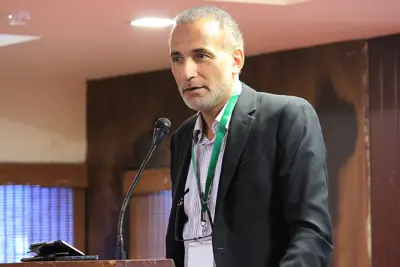
Tariq Ramadan is a Swiss Muslim academic, philosopher, and writer. He was a professor of contemporary Islamic studies at St Antony's College, Oxford and the Faculty of Theology and Religion, University of Oxford, but as of 2018 is taking an agreed leave of absence. He is a visiting professor at the Faculty of Islamic Studies at Hamad Bin Khalifa University in Qatar, and the Université Mundiapolis in Morocco. He is also a senior research fellow at Doshisha University in Japan. He is the director of the Research Centre of Islamic Legislation and Ethics (CILE), based in Doha. He is a member of the UK Foreign Office Advisory Group on Freedom of Religion or Belief. He was elected by Time magazine in 2000 as one of the seven religious innovators of the 21st century and in 2004 as one of the 100 most influential people in the world and by Foreign Policy readers (2005, 2006, 2008–2010, 2012–2015) as one of the top 100 most influential thinkers in the world and Global Thinkers. Ramadan describes himself as a "Salafi reformist".
