Peter Pace Quotes
I can tell you categorically that any mal-treatment of any detainees by U.S. forces or coalition forces is totally unacceptable - that our orders have and will continue to be that we will treat everyone in our charge with - humanely and with respect.
Pace, Peter. Department of Defense News Briefing. United States Department of Defense, 4 May 2004.


The press were asking about the claim that the United States were sending detainees (“rendition” it is called) in the War on Terrorism to countries where they are tortured in ways that United States law prohibited. This quotation is an excellent illustration of the nuanced language that is sometimes used by politicians with the press. For example this statement was made in the Press Conference about our Human Rights Annual report. In it specific countries were named and accused of torturing prisoners or suspects. The press had learned that detainees had been renditioned to those same countries. Lowenkron went on to explain that U. S. officials had explained to officials of the countries to which detainees had been renditioned that the detainees should not be tortured; therefore they did not BELIEVE that they would be. So the statement was “correct” whether or not they detainees had been tortured. In another nuance, some people wondered what “we” meant—the United States or the State Department. Perhaps the State Department followed this policy and practice but the CIA may not have.


There has always been some confusion in the case of the Wars in Afghanistan and Iraq. The Geneva and Hague conventions are very clear when prisoners are official members of an state’s armed force with uniforms, insignia and ranks. It is also clear with respect to civilians. But the combatants of the insurgent and terrorist forces fall in between, and international law is less clear. The George W. Bush administration at first took the position that the captured combatants were not captured soldiers and were therefore not entitled to the treatment due that status. But the military regulations made no distinction as to how prisoners in combat should be treated. It is a very gray area, except that in either case, torture is illegal under U. S. and under International law.


This was untrue. The CIA used several forms of torture on high value detainees. The torture was psychological and physical. Even the FBI had agents who observed CIA interrogations and complained to their supervisors. For cover, the George W. Bush administration, got 3 Justice Department Attorneys to write a secret memo defining certain types of torture as “enhanced interrogation”. Water Boarding, for which American soldiers had been court martialed and convicted for torture then became enhanced interrogation, and was used on a few terrorists. Because of the rigged Justice Department memo, the CIA claimed that they did not torture people. Another thing the CIA did was to turn over enemy to the intelligence services of third countries like Egypt, where torture was used commonly with no regard for the Geneva convention or other human rights provision. CIA agents then watched and asked questions but they claimed that they did not torture which was in some sense literally true.


This statement was made before the 2012 Syrian Revolution.

Hissine Habre was the President and Dictator of Chad. He was one of the worst war criminal and murderer in the world. He and the other DDS policemen and agents were trained by the United States.


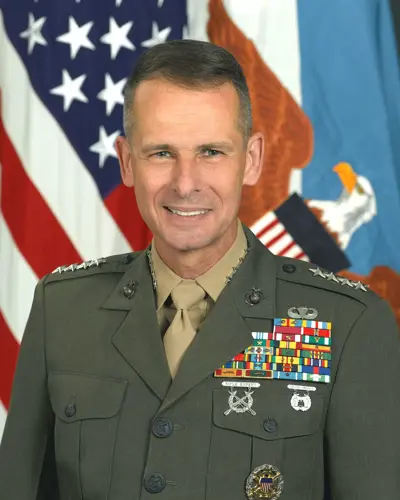
Peter Pace is a retired United States Marine Corps general who served as the 16th Chairman of the Joint Chiefs of Staff. Pace was the first Marine officer appointed as chairman, and the first Marine officer to be appointed to three different four-star assignments; the others as the 6th Vice Chairman of the Joint Chiefs of Staff from October 1, 2001, to August 12, 2005, and as Commander-in-Chief, U.S. Southern Command from September 8, 2000, to September 30, 2001. Appointed chairman by President George W. Bush, Pace succeeded U.S. Air Force General Richard Myers on September 30, 2005.
