Barry Lowenkron Quotes
We do not send detainees to countries if we believe that they will be tortured.
The press were asking about the claim that the United States were sending detainees (“rendition” it is called) in the War on Terrorism to countries where they are tortured in ways that United States law prohibited. This quotation is an excellent illustration of the nuanced language that is sometimes used by politicians with the press. For example this statement was made in the Press Conference about our Human Rights Annual report. In it specific countries were named and accused of torturing prisoners or suspects. The press had learned that detainees had been renditioned to those same countries. Lowenkron went on to explain that U. S. officials had explained to officials of the countries to which detainees had been renditioned that the detainees should not be tortured; therefore they did not BELIEVE that they would be. So the statement was “correct” whether or not they detainees had been tortured. In another nuance, some people wondered what “we” meant—the United States or the State Department. Perhaps the State Department followed this policy and practice but the CIA may not have.
Barry Lowenkron, Assistant Secretary if State for Democracy, Human Rights & Labor (Republican), State Department Press Conference on Release of the Human Rights Report, March 8, 2006
Sourced by: Eigen's Political and Historical Quotations


This was untrue. The CIA used several forms of torture on high value detainees. The torture was psychological and physical. Even the FBI had agents who observed CIA interrogations and complained to their supervisors. For cover, the George W. Bush administration, got 3 Justice Department Attorneys to write a secret memo defining certain types of torture as “enhanced interrogation”. Water Boarding, for which American soldiers had been court martialed and convicted for torture then became enhanced interrogation, and was used on a few terrorists. Because of the rigged Justice Department memo, the CIA claimed that they did not torture people. Another thing the CIA did was to turn over enemy to the intelligence services of third countries like Egypt, where torture was used commonly with no regard for the Geneva convention or other human rights provision. CIA agents then watched and asked questions but they claimed that they did not torture which was in some sense literally true.


It is surprising that these ideas would come from one of the most autocratic powerful monarch in the world at the time. However there were many very liberal influences on her from Europe. This set of proposals she even sent to Voltaire to get his feedback and criticism. As late as 2006 the American President was reluctant to outlaw torture for terroristsand the Vice President actually argued for its retention as an interrogation technique. Over 300 years earlier the autocrat of Russia argued against it.

He was referring to the police interrogation methods that Turkey had used in the past but was in the process of reforming.


Several American soldiers have been court marshalled and found guilty of illegal torture for Warterboarding prisoners to induce them to provide information. Most experts agree that intelligence received this way is highly unreliable in that victims will say anything they think the torturer wants to hear to get the torture to stop.

See {642427} for a case where the United States was accused of not living up to this treaty.

At the time CIA apologists for the torture they carried out with the facilitation of the Justice Department often justified the torture because they claimed that it worked. Critics rose to the bait and argued that proposition as there was much evidence that it did not, and nothing was learned that had not been obtained without torture. However, Cole argues that that was the wrong issue. Torture was outlawed whether it worked or not. The United States under Ronald Reagan signed the treaty and the Senate ratified it. Torture is wrong whether or not it works.


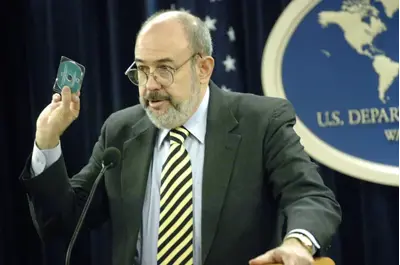
Barry F. Lowenkron (born 1952) is an American specialist in foreign relations. He was Vice President of the Program on Global Security & Sustainability at the MacArthur Foundation from 2007 to 2014.
