George McGovern Quotes
I assume that everyone here is impressed with my control of this convention as my choice for the vice president was challenged by only 39 other nominees.
At that time the Presidential nominee had influence but could not unilaterally determine who his running mate would be as the Party Conventions—especially the Democratic Party Convention—was wide open. The candidate joked in this quotation, but the party leaders were very unhappy with such an open convention and after the 1972 election which they lost handily, the rules were changed to give party leaders more influence. By the 21st century, the primary elections had all but made the party conventions a quaint celebration and no serious decisions were made by the party leaders or the party delegates.
George McGovern, U. S. Congressman & U. S. Senator (Democrat, SD), Presidential Nomination Acceptance Speech, Democratic National Convention, 1972
Sourced by: Eigen's Political and Historical Quotations


During the last days of the 1912 "Bull Moose" campaign, President Taft's running mate, Taft’s Vice President James S. Sherman, died just before election day. Nicholas Butler was asked to take his place on the Republican ballot; he agreed with this famous condition. The election was won by Democrat Woodrow Wilson and Butler was off the hook.

Abraham Lincoln was the only third party candidate to win the presidency in U.S. history. However, when he was nominated, there was little conviction among Republicans that a third or fourth party could actually win:. Lincoln's primary opponent, William H. Seward

Ever since the beginning of the Republic, the major source of Federal revenue was customs duty from New York. The collector employed a massive bureaucracy and was then one of the largest patronage controller in the country. Thurlow Weed and other New York political bosses offered Abraham Lincoln their political support if Lincoln would give them control of the patronage. On September 5, 1864 Lincoln fired his man, Hiram Barney, and replaced him with Draper. The new collector promptly replaced key personnel down the line and stated publicly:

In 1989 Russia held contested elections for the first time since the 1917 revolution. Numerous incumbent party leaders lost.


The three richest men in America—John D, Rockefeller, Andrew Carnegie, and Morgan, usually major rivals—had gathered together to decide what to do about William Jennings Bryan, who they viewed as very hostile to business and capitalism. (See {641037} and {641038} for Bryan quotation examples that concerned them.) They agreed to combine their efforts and back William McKinley who was running for the Republican Presidential nomination. In those days, the nominee was chosen by a small group of party leaders and their resources guaranteed McKinley the post. They then put large amounts of money to campaigning against Bryan and for McKinley including dirty tricks, many of which are illegal today. It is not known for certain whether McKinley knew the extent of the involvement of the monopolists, but shortly after assuming the Presidency he cut back on many of the relatively few regulations that then existed to control unbridled capitalism. Their effort went for naught when McKinley was assassinated and Theodore Roosevelt became President. Roosevelt would not be bribed or intimidated, and he did more to control monopolies than even Bryan would likely have.

Harriman was the senior Democratic leader of the era. Every aspiring Democratic politician would make it his business to get to meet Harriman and try and get his endorsement. However, Carter was not a typical politician and when he decided to run for the Presidency, he had not even met many of the leading Democratic Party leaders. Harriman, a man of the old school, could not believe that anyone in the party who he did not know could possibly have the connections and the sophistication to win the presidency. However, Watergate had seared the American political soul and voters were not looking for a veteran, sophisticated politician. Nixon had been that.


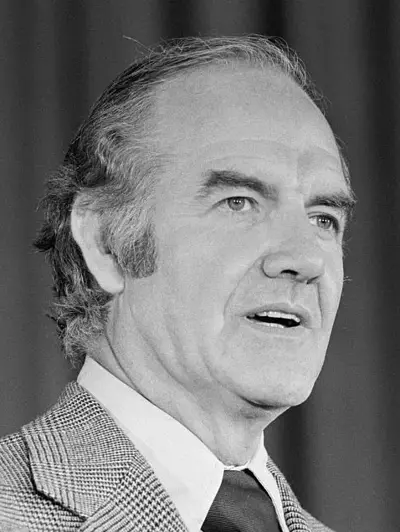
George Stanley McGovern was an American politician, historian, U.S. representative, U.S. senator, and the Democratic Party presidential nominee in the 1972 presidential election.
