Roscoe Conkling Quotes
If the question at Chicago had been who shall be the next President? instead of who shall be the candidate? beyond all question the choice would have fallen on New York's illustrious statesman .
Abraham Lincoln was the only third party candidate to win the presidency in U.S. history. However, when he was nominated, there was little conviction among Republicans that a third or fourth party could actually win:. Lincoln's primary opponent, William H. Seward
Roscoe Conkling, 1829-1888, U. S. Congressman & U.S. Senator (Republican, NY), Speech, 1860
Sourced by: Eigen's Political and Historical Quotations


This is one of the great erroneous predictions of American political history. He was not nominated on the second ballot. Nor on the third; Lincoln was


The wording implied that if the upcoming convention should draft him for a second term, he would run. But the convention was more interested in politics than in exegesis. Coolidge was ignored, and Herbert Hoover won the nomination.


Smith had written to most of the then likely Presidential candidates of both major parties asking for their position on the Mormons who were facing persecution wherever they went. None of the politicians would make any satisfactory commitments. Smith took Direct Action and became the only major religious official to have run for the Presidency of the United States until Pat Robertson tried and failed in 2000. Smith’s assassination shortly thereafter cut his run for the Presidency short before it made much headway and politically he had no chance to affect the race.

He was a liberal Republican in an era where the Republican paty was controlled by arch conservatives, the Tea Party extremists, and evangelical Protestants while Gullani was divorced, a Catholic, and lived openly with a woman to whom he was not married. He supported a woman’s right to abortion and gay rights.

At that time, the right wing of the Republican party was so anti-Federal Government, that they would de facto veto any Washington Politician who tried to get the Presidential nomination.

Questioning the wisdom of the then existing system of selecting major party presidential candidates by primary elections where even few party members vote.


Seward, the powerful Governor of New York, was the heavy favorite for the Republican Presidential nomination in 1860 and the “big story” for the journalists of the time was his failure to secure the nomination. Lincoln, who prevailed and then was elected President, in a remarkable political act, asked Seward and Lincoln’s other rivals to join his cabinet.
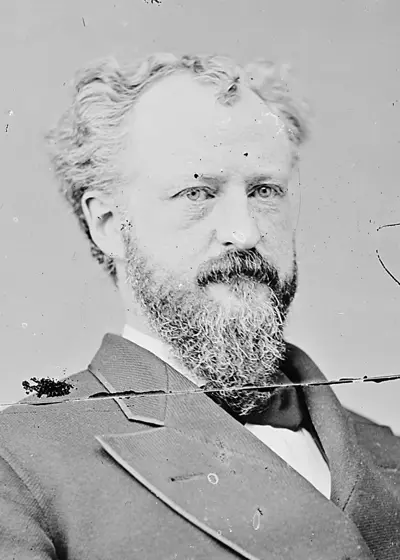
Roscoe Conkling was a lawyer and politician from New York who served both as a member of the United States House of Representatives and the United States Senate. He was the leader of the Stalwart faction of the Republican Party, the first Republican senator from New York to be elected for three terms, and the last person to turn down a U.S. Supreme Court appointment after he had already been confirmed to the post. While in the House, Conkling served as bodyguard for Representative Thaddeus Stevens, a sharp-tongued anti-slavery representative, and fully supported the Republican war effort. Conkling, who was temperate and detested tobacco, was known for his physical condition, maintained through regular exercise and boxing, an unusual devotion for his time. Conkling was elected to the Senate in 1867 as a leading Radical, who supported the rights of African Americans during Reconstruction.
