William Eaton Quotes
I am not certain whether we can afford your friendship, be it eternal or merely temporary. I fail to see the difference between what you define as friendship and what civilized nations call enmity.
Ahmed Pasha, the Bey (provincial governor) of Tunis, offered a bribe to William Eaton stating that his country would enter into friendship with America and not go to war with Tripoli against America if he received a hefty tribute from America.
William Eaton, 1764-1811, Diplomat, Army Officer, Statement to Ahmed Pasha, 1801, Quoted in Edwards, Barbary General
Sourced by: Eigen's Political and Historical Quotations


While this was a common attitude for years before, the horrors of World War II produced a general revulsion to war and an awareness that war between two nations spills over to other states in the region and in an era of globalization, effects countries in other parts of the world. So there has been a tendency to use diplomacy endlessly, even after "things have gone too far". Historically, when things reached that point, the parties did fight it out, and when one was weakened sufficiently, negotiations and diplomacy could then be fruitful.

This quotation shows The Prophet relaying a message from Allah. This quotation is often used to explain the reason that Islamic nations often support each other regardless of interests, legality, or morality of the position. If the other Muslim nation is a friend of Allah’s, and one opposes the other Islamic nation, then one is not only standing against Allah’s “friend” but Allah himself might make war on you for standing against his friend. So for Islamic nations like Turkey and Pakistan to even be supportive of anti-terrorist activities against Islamic terrorists is a politically, culturally and religiously very difficult thing to do because fundamentalists will cite this quotation and warn that the policy may well be “standing in enmity” against one of Allah’s friends. For most Islamic nations, their religious culture produces a basic instinct to support other Islamic nations against heretics (the Judeo-Christian West or the Hindu-Buddhist East) lest Allah declare war on them.


The first Bishop in Britain, sent by Pope Gregory in 597. This was in large part fulfilled in 607 when Ethelfrith led Saxon troops to Wales killing many including 200 priests who had been sent to pray for the Welsh.


The Iroquois had a very successful confederacy of 6 tribes in a relatively democratic government with a written constitution. They dominated the Eastern part of North America for years. The were able to maintain a permanent unity with a unified and decentralized combination of government—much like the United States would become. At the time of this advice, each American colony was a government unto itself. The three Iroquois Indian delegates were Canassatego, Tachanoontia, and Gachradodow.


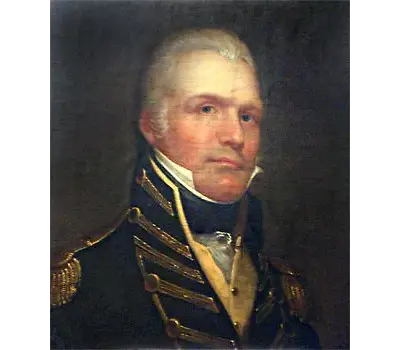
William Eaton was a United States Army officer and the diplomatic officer Consul General to Tunis (1797–1803). He played an important diplomatic and military role in the First Barbary War between the United States and Tripoli (1801–1805). He led the first foreign United States military victory at the Battle of Derne by capturing the Tripoli subject city of Derne in support of the restoration of the pasha (local monarch), Hamet Caramelli. William Eaton also gave testimony at the treason trial of former Vice President Aaron Burr. He served one term in the General Court of Massachusetts (state legislature). Eaton died on June 1, 1811 at the age of forty-seven.
