Joseph Cannon Quotes
Never attempt to buy the favor of your enemies at the expense of your friends.
Joseph Cannon, 1836-1926, U. S. Congressman (Republican, IL), Speaker of the House, Quoted in Quoted in Busby, Uncle Joe Cannon
Sourced by: Eigen's Political and Historical Quotations


This quotation shows The Prophet relaying a message from Allah. This quotation is often used to explain the reason that Islamic nations often support each other regardless of interests, legality, or morality of the position. If the other Muslim nation is a friend of Allah’s, and one opposes the other Islamic nation, then one is not only standing against Allah’s “friend” but Allah himself might make war on you for standing against his friend. So for Islamic nations like Turkey and Pakistan to even be supportive of anti-terrorist activities against Islamic terrorists is a politically, culturally and religiously very difficult thing to do because fundamentalists will cite this quotation and warn that the policy may well be “standing in enmity” against one of Allah’s friends. For most Islamic nations, their religious culture produces a basic instinct to support other Islamic nations against heretics (the Judeo-Christian West or the Hindu-Buddhist East) lest Allah declare war on them.


President Johnson was trying to organize peace talks in Paris. Nixon didn’t want a public announcement to occur before election day when he was running against Hubert Humphrey. Knowing the South Vietnamese President was reluctant to go to Paris but was under pressure from America to do so, he sent a message through Chennault that he should not accept and “hang on” as Nixon would shortly win. The South Vietnam president refused to go to Paris, Nixon won the election, and then had to cope with the continuation of the war that might well have ended before he took office. Nixon believed that he could get Russia and China to pressure Ho Chi Min to make peace. Nixon's private overtures to the South Vietnam president, violated the Logan Act which prohiited private citizens negoatioating with foreign governments. President Johnson was aware of Nixon's commission of this felony want wanted to prosecute him, but the evicence had been obtained from secret intelligene agency bugging and wiretapping both the South Vietnam Embassay in Wishington and the Presidential Palace in Vietnam the public knowledge of which would have caused a scandal. Instead, he called Nixon and warned him to stop, but the damage had already been done, and the South Vitenamese government would not go to Pariis where they would have to agree to a coalition government with the Communists. THey waited for Nixon to deliver a peace treaty which would leave them in charge of South Vietnam. In the final analysis, the South Vietnamese ended up with nothing and no participation in anything when the U. S. Withdrew and the Communists took over.


Ahmed Pasha, the Bey (provincial governor) of Tunis, offered a bribe to William Eaton stating that his country would enter into friendship with America and not go to war with Tripoli against America if he received a hefty tribute from America.


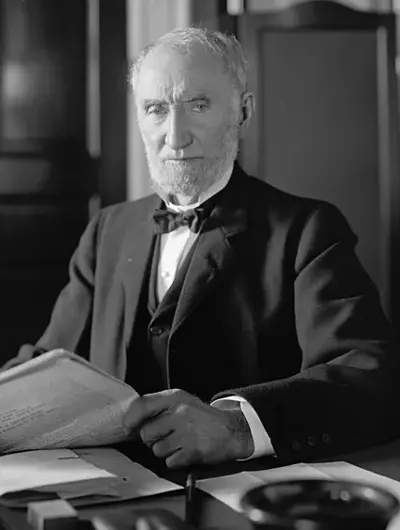
Joseph Gurney Cannon was a United States politician from Illinois and leader of the Republican Party. Cannon served as Speaker of the United States House of Representatives from 1903 to 1911, and many consider him to be the most dominant Speaker in United States history, with such control over the House that he could often control debate. The Cannon House Office Building, the oldest congressional office building, completed in 1908, was named for him in 1962.
