Robert Smalls Quotes
Hereafter in the enlistment of men in the Army... no distinction whatsoever shall be made on account of race or color
It would be over 80 years before President Harry S Truman accomplished the result by issuing an Executive Order.
Robert Smalls, 1839-1915, U. S. Congressman (Republican, SC), Army General, Delegate to the South Carolina Constitutional Convention, Unsuccessful Resolution Introduced into the House of representatives
Sourced by: Eigen's Political and Historical Quotations

When the Democrats won the presidency, there was great fear that all the appointments that Blacks had garnered would be undone as the results of the Southern racist element of the Democratic party. The President held the line, much to the distress of his Southern supporters.

The power structure of England and the English administrators of South Africa were strong advocates of racial equality at the beginning of the 19th century. They insisted on equal administration of law. However the Boer white population could think of nothing more absurd. In a sense the Boers were much like the Southern Whites at the same time. The South African government however could not enforce its equality policies in the rural area – the majority of South Africa at the time. When democracy and self rule came to South Africa, the racially moderating force of the English was minimized and the majority of South Africans wanted a racially segregated society. Apartheid resulted.


The Prime Minister had begun his career as a proponent of apartheid, but by 1990 had reversed course.


The decision was 5-4 and reversed a trend in which the court had been going before. Roberts and another appointment by George W. Bush tilted the majority. See {614911} for a quotation from the 4 justice dissent.


He was the first FHA administrator to make statements saying that non-discriminatory housing services should be available to the American people. He was not able to change the agency’s equal opportunity performance because the Southern states had laws allowing and protecting legal segregation especially in housing. The Southern staff interpreted his position to be sure that both blacks and whites had access to FHA services, but they used the “separate but equal” doctrine: Provide services to both races but always in segregated housing projects. This was typical of the kinds of problems that motivated the Civil Rights Acts offered by President Kennedy in 1963 and passed by President Johnson in 1964 See {637271} for a similar Mason statement.

Clinton was reacting to questioning about gays in the military.


Jackson was a great champion of equality and equal rights, but for whites only. He had no problem with Negro Slavery and had a major bias against Indians. He was the only U. S President to refuse to obey a decision of the Supreme Court when he forced the removal of the Cherokee Indians from their lands and forced them to the Oklahoma Territory.


The rights possessed by the Arab minority of Israel exceeds not only those of Jews in any Arab nation, and exceeds those of any minority in an Arab state. And because Israel is the only democracy in the Middle East, the Arabs of Israel possess more political rights than do Arabs anywhere else in the Middle East. The number of Arab political parties in Israel is larger than that of most Arab nations where opposition parties are rarely permitted.


The function of government is to

Southerners and some others wanted to discriminate and fought civil rights legislation. The excuse they gave for opposition was that the Federal Government was usurping the power of the states to determine what civil rights people of the state would have. Shellabarger made it clear that the civil rights bill would not require ANY rights to be given. It just required that if the states granted rights, they could not discriminate by race as to those rights. But the states were free to decide which rights all citizens of the state would have. See {623473} .
This statement in the President’s Second Inaugural. Infuriated the politicians of the Southern States. Remember, at the time there was brutal discrimination throughout most of the South, and more important to the South than the fact if the discrimination was their perverse view that this was a right, proper and necessary state of affairs for the welfare of the people and was required by Christianity’s mandates as they read the Scripture. For the President to state so publicly that discrimination was contrary to the law, justice, good faith, citizenship and fairness was a major shock. Since the early days of reconstruction after the Civil war in the Grant Administration, no president had spoken so publicly and openly against the Southern status quo.


He was reacting to the racial claims of Adolph Hitler in German
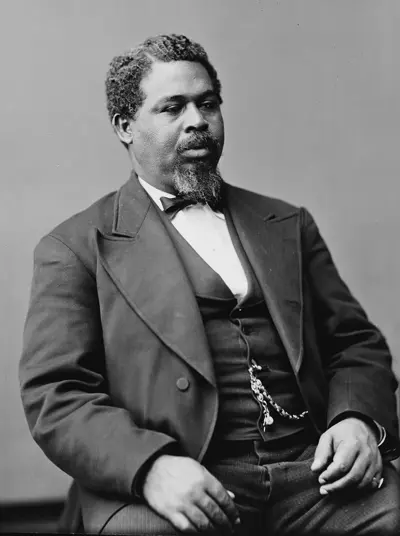
Robert Smalls was an American politician, publisher, businessman, and naval pilot. Born into slavery in Beaufort, South Carolina, he freed himself, his crew, and their families during the American Civil War by commandeering a Confederate transport ship, CSS Planter, in Charleston harbor, on May 13, 1862, and sailing it from Confederate-controlled waters of the harbor to the U.S. blockade that surrounded it. He then piloted the ship to the Union-controlled enclave in Beaufort-Port Royal-Hilton Head area, where it became a Union warship. His example and persuasion helped convince President Abraham Lincoln to accept African-American soldiers into the Union Army.
