Howard Hughes Quotes
Hell's Angels
Flying Tigers were American Mercenary Volunteers fighting for China against Japan before Pearl Harbor. The name was adopted in 1947 by a California group of disaffected World War II veterans who rode motorcycles.
Howard Hughes, 1905-1976, Industrialist, Aviator and Film Producer, Name of Film, 1930, The name was later given to one of the three Flying Tiger airplane squadrons in 1941
Sourced by: Eigen's Political and Historical Quotations


The advances of battlefield medicine produced a very large increase in the number of wounded veterans and an unprecedented demand for nurses and other medical personnel. In the Iraq war over half a century later, the need exploded still further. But the need to “serve those who served” approach has not been tried.

The Emperor was writing to his son to explain the defeat of Japan. In what was a bit of revisionist history, the Emperor neglected to mention that with the exception of some of the incursions in China, Hirohito had personally approved every Japanese invasion including Pearl Harbor. Further, it was he who had approved the orders that Japanese troops should fight to the death rather than retreat or surrender.
In Japan at that time there was no civilian control of the military and the military resented any attempt at the civilian government to influence military affairs in any way whatsoever. At the same time the military often tried to influence the politics of civilian government. The Emperor made this feeble effort to inhibit that, but as World War II proved, he had not tried very hard to prevent the military from dominating the country.

It was this directive, together with the evidence of its acceptance by the Japanese soldier fighting to the death in Saipan and Okinawa, that lead President Truman and Chief of Staff Marshall to conclude that more lives would be saved by using the atomic bomb than invading the Japanese mainland. See {641063}
Commenting on the hostility which greeted some returning Vietnam veterans:


This statement caused great consternation. NcNutt did try to explain that he was speaking personally and not for the Government, but there was a small proportion of America who had concluded that all Japanese should be killed. Such an concept which was unthinkable 5 years earlier was considered as a result of several factors: The Japanese had murdered many American prisoners of war. Killed millions of civilians throughout Asia including doing medical and weapons experiments on live human beings. They had practiced torture, compulsory prostitution and mass rape of conquered territories. At the same time, the Germans had tried to exterminate all the Jews and, with some Japanese help, did kill two-thirds. The concept of genocide had been introduced to Americans as the concentration camps were liberated. And American casualties in the Pacific had been heavy. Vengeance was desired by many. Fortunately, the overwhelming majority of Americans never considered genocide seriously.
This document was used at the trials of the Japanese War Criminal at the end of WWII. However, MacArthur would not allow the prosecution of all who were guilty of murdering helpless crews of Allied ships after they were disabled. He just wanted a few examples and even would not try the Emperor whom he felt was more useful in his position than as a criminal.

The Senator was an Army sergeant fighting in Europe during WWII. He and a unit of Japanese American had volunteered to fight for America at the same time as many other Japanese Americans – American Citizens -- on the West Coast were interned in camps and denied the very rights we were fighting to preserve. The internment was one of the most regrettable mistakes in American history.

Many of the young men who were given this form to fill out, had never been in Japan and some did not even know there was an emperor there. Nonetheless the Japanese American divisions of enlistees were the most effective and most decorated fighting units for America while their parents who had not been born in America were still imprisoned in the internment camps. See {624010}.

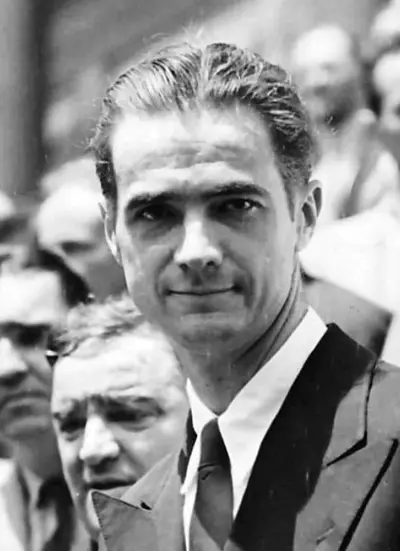
Howard Robard Hughes Jr. was an American business magnate, investor, record-setting pilot, engineer, film director, and philanthropist, known during his lifetime as one of the most financially successful individuals in the world. He first became prominent as a film producer, and then as an influential figure in the aviation industry. Later in life, he became known for his eccentric behavior and reclusive lifestyle—oddities that were caused in part by his worsening obsessive-compulsive disorder (OCD), chronic pain from a near-fatal plane crash, and increasing deafness.
