Calvin Coolidge Quotes
He who builds a factory builds a temple; he who works there worships there.
Coolidge was extremely pro business. See {598686}.
Calvin Coolidge, 1872-1933, 30th President of the United States (Republican, MA), Quoted on The History Channel, The Presidents, November 24, 2005
Sourced by: Eigen's Political and Historical Quotations

Sometimes this is misquoted as 'The business of America is business.' See Woodrow Wilson for an earlier statement of this idea which is almost always incorrectly attributed to Coolidge as the originator of the idea.


The left has always been ambivalent about automation. Many object to it on the grounds that it puts men out of work. However, others such as Lafage, argued that automation was the only economic way to reform the working hours and conditions of labor. The problem at the time was that as long as labor was so cheap, there was no motivation for the manufacturer to invest in better machinery. He and many others argued that minimum wages and their increases increase productivity because it would force manufacturers to invest in more productive equipment to reduce their labor costs.


At the time very few industrialists appreciated the value of particular workers and tended to think of them as interchangeable parts.


These work hours, 6 days a week were typical for Russian workers of the time. The Russian workers were ripe for any revolution or reform that promised a better life.

Ironically, Fitzhugh who detested socialism, held this basic socialist principle. His solution however, was that the profits were necessary for society, and therefore slavery was the solution for Blacks AND whites.

At the time, the mine owners and operators claimed that they had NO obligations to their workers—not even to ensure a safe mine. There was no OSHA and workers died and were maimed on the job much more frequently than they do today. Many mine owners now accept that they have obligations to the workers, and the rest are required to have responsible and safe working conditions by law and OSHA regulations.


He had squads of thugs that he would “rent” out to other gangsters for their enforcement activities and to unions to protect themselves from goons and intimidate non union workers. However, he would not let his men work as goons and strike busters or for companies—despite huge pay offers—to keep their workers in line, a common practice at the time.


Steel workers were then paid $1.75 for a 9 hour day. This was earthshaking.

Ten cents a day was a very low wage—it was about the equivalent of a meal at a tavern at the time. Workers throughout the country were outraged and give him a derogatory nickname—see Quotation 643585.


Earlier, Jefferson was opposed to manufacturing in America as factories were a social blight in Europe which he wanted to keep out of the United States. He felt that we could import whatever we needed from Europe and not have the evils of industrialization. However, with the War of 1812, the Barbary Pirates and his mellowing when no longer President, and his willingness to change his positions as he learned more, caused him to what we would label today as “flip flop”. He then wrote this and {615635}.

She was running for the Democratic Presidential Nomination.

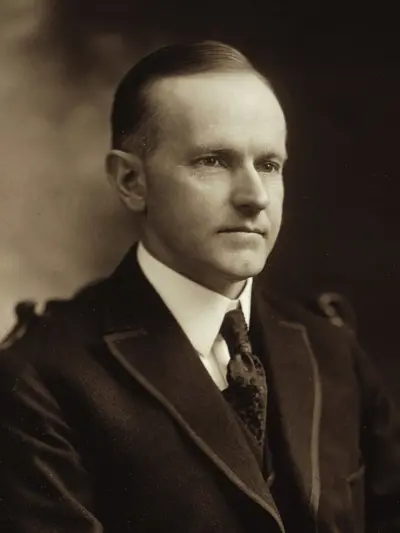
- Born: July 4, 1872
- Died: January 5, 1933
- Nationality: American
- Profession: President
Calvin Coolidge was an American lawyer and politician who served as the 30th president of the United States from 1923 to 1929. A Republican lawyer from New England, born in Vermont, Coolidge worked his way up the ladder of Massachusetts state politics, eventually becoming governor of Massachusetts. His response to the Boston Police Strike of 1919 thrust him into the national spotlight and gave him a reputation as a man of decisive action. The next year, he was elected the 29th vice president of the United States, and he succeeded to the presidency upon the sudden death of Warren G. Harding in 1923. Elected in his own right in 1924, he gained a reputation as a small-government conservative and also as a man who said very little and had a rather dry sense of humor.
