Calvin Coolidge Quotes
He was against it.
After returning from church one Sunday, Coolidge’s wife asked him what the sermon was about and in his usual taciturn manner, he replied, “Sin.” His wife asked for details about what the preacher specifically said and this was his answer.
Calvin Coolidge, 1872-1933, 30th President of the United States (Republican), Quoted in McKee, Coolidge Wit and Wisdom, 1933
Sourced by: Eigen's Political and Historical Quotations


Conant was also one of America’s premier scientists why had served on all the government policy committees about the atomic bomb development and use. He was the only scientist who had the respect of the greatest of the scientists and also was a respected government administrator with the confidence of the politicians. The “super” was the name then for the Hydrogen Bomb, a logical next step that could be taken according to the laws of physics. However J. Robert Oppenheimer and the Atomic Energy Commission General Advisory Committee he was chairing voted unanimously to NOT develop the Hydrogen Bomb at the time. The feeling was that if we did, the Russians would feel that they too would have to also, and their physicists were estimated to be easily capable of doing it. They thought that we could easily build more atom bombs—enough to wipe out Russian civilization if they attempted to use any of the atomic weapons they had built. The Chairman of the AEC and some other civilian officials who did not really understand the science but were they thought knowledgeable about international power politics, wanted to go ahead and build the “super” which Edward Teller had recommended and led the very few scientists on that side of the issue. The civilian hawks’ logic was that the Russians were so inferior to the United States that they could not have developed their atomic capability without having the information from their spies who had penetrated out program. If we built a supply of hydrogen weapons, they argued, the Russians could never gain parity if we maintained proper secrecy. They were not good enough scientists. Therefore we would dominate the world and could contain communism. Conant and most other American scientists knew that the Russians could develop supers and then we would be in a scientific arms race which in all probability we would not win every stage. Better they thought to have a stand off. However, the AEC Chairman started a campaign to destroy Oppenheimer’s credibility with the public as he was the public face of American Physics. The scientists lost the worst fight in American history between politicians and scientists. Conant, himself was appointed to literally be the peacetime ruler of West Germany and had a brilliant success there, but he was unable to stop the super development after Oppenheimer had been publicly castigated as a security leak. The Russians then developed their hydrogen weapons and the arms race continued throughout the Cold War as most of the scientists thought it would.


As Secretary of State, Powell was going to address the UN Security Council on the 5th and he was coordinating his speech with the other agencies of the government. His criterion was that he only wanted to make accusations that were backed up by incontrovertible evidence. However, VP Richard Cheney and his aide, Scooter Libby, kept inserting an accusation that Iraq was involved with and supported Al Qaeda. This was one of the many speculations that those who wanted to justify attacking Iraq kept using as Domestic propaganda. When Powell asked for proof or intelligence reports and none could be provided, he removed the accusation from the speech explaining why. However, at the last minute, Cheney and his staff put the accusation back in, and that triggered the quotation. Unfortunately, Powell was so busy fending off totally absurd accusations, that he accepted the CIA assurances {79468} that Iraq was developing nuclear weapons that were about to be operationalized and never heard from those who questioned the credibility of the sources for the basic accusation. Powell had great trust among the diplomats of the world then gave the United States version to the Security Council and justified our coming invasion of Iraq. But the intelligence report, despite the assurances of the CIA and the Vice President, was false and Iraq not only was not close to a nuclear weapon but he had no program at all at that time to try and develop one. Powell resigned and his credibility about the world was ruined as he was then seen as just another lying politician.

The Torah, the first 5 Books of the Bible, are the statement of Jewish law. The Talmud is a compendium of commentary on Jewish Law—–reflecting the views of a number of learned Rabbis of old. In a sense, they are much like legal opinions from many different judges. They are disparate views and often contradict on another. Few if any other religions, have an official document like it. Other religions key documents are prescriptive, and where there are occasional contradictions , effort is made to rationalize. However Judaism has the strong religious tradition of dissent from singular dogma. Different Jewish sects and groups differ in what in the Talmud they follow, and Reform Jews, the largest group in America, assume a continuing discussion of the Talmud with the ancient Rabbis having no more weight in their opinions that modern thinkers—–theologians, philosophers, and others.


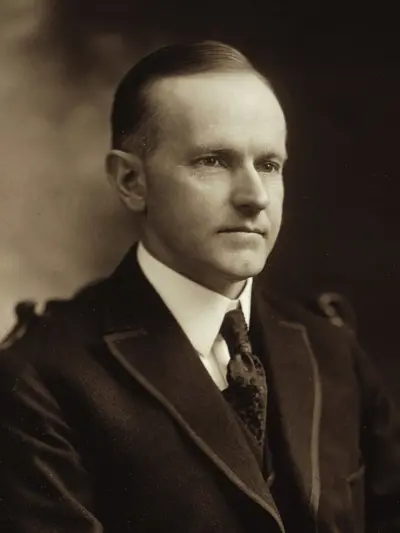
Calvin Coolidge was an American lawyer and politician who served as the 30th president of the United States from 1923 to 1929. A Republican lawyer from New England, born in Vermont, Coolidge worked his way up the ladder of Massachusetts state politics, eventually becoming governor of Massachusetts. His response to the Boston Police Strike of 1919 thrust him into the national spotlight and gave him a reputation as a man of decisive action. The next year, he was elected the 29th vice president of the United States, and he succeeded to the presidency upon the sudden death of Warren G. Harding in 1923. Elected in his own right in 1924, he gained a reputation as a small-government conservative and also as a man who said very little and had a rather dry sense of humor.
