William E. Gladstone Quotes
It is no use for the honorable member to shake his head in the teeth of his own words.
Gladstone, William E. Speech in the House of Commons.


When accused of being a baby killer for her views on abortion:

After returning from church one Sunday, Coolidge’s wife asked him what the sermon was about and in his usual taciturn manner, he replied, “Sin.” His wife asked for details about what the preacher specifically said and this was his answer.


As Secretary of State, Powell was going to address the UN Security Council on the 5th and he was coordinating his speech with the other agencies of the government. His criterion was that he only wanted to make accusations that were backed up by incontrovertible evidence. However, VP Richard Cheney and his aide, Scooter Libby, kept inserting an accusation that Iraq was involved with and supported Al Qaeda. This was one of the many speculations that those who wanted to justify attacking Iraq kept using as Domestic propaganda. When Powell asked for proof or intelligence reports and none could be provided, he removed the accusation from the speech explaining why. However, at the last minute, Cheney and his staff put the accusation back in, and that triggered the quotation. Unfortunately, Powell was so busy fending off totally absurd accusations, that he accepted the CIA assurances {79468} that Iraq was developing nuclear weapons that were about to be operationalized and never heard from those who questioned the credibility of the sources for the basic accusation. Powell had great trust among the diplomats of the world then gave the United States version to the Security Council and justified our coming invasion of Iraq. But the intelligence report, despite the assurances of the CIA and the Vice President, was false and Iraq not only was not close to a nuclear weapon but he had no program at all at that time to try and develop one. Powell resigned and his credibility about the world was ruined as he was then seen as just another lying politician.

This quotation illustrates a great problem with treaties in international law. Here an opponent of the Egyptian regime and one who disapproves of the regime before it, wants to repudiate the treaties that had been signed by previous Egyptian governments. So when there is a regime change, can a new regime repudiate earlier treaties? International law says no, but if a new government refuses to follow its obligations, then it is left to the other treaty partners to put pressure on them--breaking diplomatic relations, trade sanctions, even war. For example, President Thomas Jefferson made a treaty with the French Dictator Napoleon and bought the Louisiana Territory which includes a number of current American states. If a new French government abrogated the treaty of the dictator on the grounds that it did not represent the will of the French people and tried to take back their land, war could ensue. Nations very rarely repudiate treaties for if they did, who would sign any new ones?
Shortly after Henry Morgenthau had become Secretary of the Treasury he held a press conference. A veteran reporter asked him very difficult, detailed technical financial questions which the Secretary had not been exposed to. He observed of the reporter, "You must be new here."


Conant was also one of America’s premier scientists why had served on all the government policy committees about the atomic bomb development and use. He was the only scientist who had the respect of the greatest of the scientists and also was a respected government administrator with the confidence of the politicians. The “super” was the name then for the Hydrogen Bomb, a logical next step that could be taken according to the laws of physics. However J. Robert Oppenheimer and the Atomic Energy Commission General Advisory Committee he was chairing voted unanimously to NOT develop the Hydrogen Bomb at the time. The feeling was that if we did, the Russians would feel that they too would have to also, and their physicists were estimated to be easily capable of doing it. They thought that we could easily build more atom bombs—enough to wipe out Russian civilization if they attempted to use any of the atomic weapons they had built. The Chairman of the AEC and some other civilian officials who did not really understand the science but were they thought knowledgeable about international power politics, wanted to go ahead and build the “super” which Edward Teller had recommended and led the very few scientists on that side of the issue. The civilian hawks’ logic was that the Russians were so inferior to the United States that they could not have developed their atomic capability without having the information from their spies who had penetrated out program. If we built a supply of hydrogen weapons, they argued, the Russians could never gain parity if we maintained proper secrecy. They were not good enough scientists. Therefore we would dominate the world and could contain communism. Conant and most other American scientists knew that the Russians could develop supers and then we would be in a scientific arms race which in all probability we would not win every stage. Better they thought to have a stand off. However, the AEC Chairman started a campaign to destroy Oppenheimer’s credibility with the public as he was the public face of American Physics. The scientists lost the worst fight in American history between politicians and scientists. Conant, himself was appointed to literally be the peacetime ruler of West Germany and had a brilliant success there, but he was unable to stop the super development after Oppenheimer had been publicly castigated as a security leak. The Russians then developed their hydrogen weapons and the arms race continued throughout the Cold War as most of the scientists thought it would.

After coming to power in a coup, he had been in office for 22 years, and had been elected in less than "fres and fair" elections. As in many dictatorial nations, the ruler so contols the media and surpresses significant opposition so that he can obtain the "ligitimacy" of having been elected. However in 2016, despit his control of the entire system, public opinion was so much against him, that even with the various devices and artifices to control; the election, he lost. His repose was to claim that the election was fraudulent and tained and pointed to evidence of such. However the actions he claimed tainted the elections were all done by his minions tryiing to rig the election in his favor.
_0_PostageStamp_47x47.jpg "Chairman of the Joint Chiefs of Staff Navy Adm. Mike Mullen gives an interview to John Dickerson during the CBS news program Face the Nation in Washington, D.C., July 5, 2009. During the interview, Mullen discussed the wars in Iraq and Afghanistan, North Korea's recent missile tests and his recent visit to Russia. (DoD photo by Mass Communication Specialist 1st Class Chad J. McNeeley, U.S. Navy/Released)")

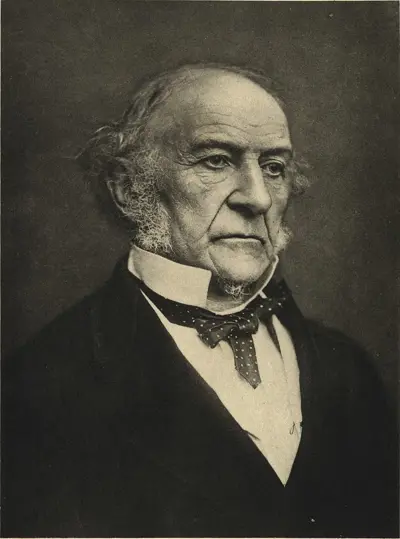
William Ewart Gladstone FRS FSS was a British statesman and Liberal politician. In a career lasting over 60 years, he served for 12 years as Prime Minister of the United Kingdom, spread over four terms beginning in 1868 and ending in 1894. He also served as Chancellor of the Exchequer four times, serving over 12 years.
