Kate Adie Quotes
Hair is also a problem. I remember once, when I was reporting from Beirut at the height of the civil war, someone wrote in to the BBC complaining about my appearance.
Adie, Kate. "Kate Adie Webchat." The Guardian, 15 Oct. 2002.


Until the 20th century almost all American political media were shamelessly and overtly biased—left or right. Political Parties had their own de facto publications much like Fox News became for the Republicans in the 21st century. In the 20th century journalism developed into a profession that evolved standards of objectivity in reporting. That norm then prevailed for about 70 years. With the extreme polarization of the later years of the 29th Century the right wing began to accuse much of the media of a left wing bias, and the media tended to react as Krugman describes in this quotation. The model of having spokespersons for “each side” of an issue works for highly subjective political preferences with a two party system, but where it broke down is with scientific and technical issues. On these, there often really are not two scientific points of view, but there is a scientific consensus of the vast majority of scientists and almost all the prestigious and accomplished scientists are in accord. However, there may be some who have a cultural, religious and/or political concern for some science and its implications for society. They in turn find a scientist or two, often one who is unaccomplished and not recognized in the scientific field to argue a different point of view. The media have tended to equate the two and have a “debate” as if there were two sides to the science when there are not. These issues tend to cluster around scientific medical issues involving sex and birth control methods, environment and conservation, evolution, the age of the earth and the method of creation of the universe. The problem is particularly exacerbated by the general scientific illiteracy of the American population and the relatively few journalists who themselves are scientifically literate who can explain scientific issues well.

The patch over her eye in the photo reflected the loss of one of her eyes when she was covering the civil war in Sri Lanka. She was struck with shrapnel. She continued her reporting despite the great risk. In February 2012, the building she and other journalists were taking shelter in was shelled by government heavy artillery and she and others were killed.


This concept of Total War turns out to be the only way to bring many conflicts to an end. Sherman was hated by generations of Southerners because he appeared to be vengeful to humble the Southern pride and spirit. But actually, Sherman was not personally vengeful at all and respected the South and understood its point of view more than most in the North. However, he was one of the first of the Western World’s military leaders to realize that with modern warfare and the then modern weapons, the only way to win a war was to persuade the enemy to stop fighting and if they refused, as the South kept doing, the only rational and humane course was to end the war as swiftly and totally as possible.
He was a realist who foresaw that even though the South had been militarily defeated, there were those who would persist in their efforts to retain slavery or a de facto form where freedom is the form but subjugation was the substance. It would be Jim Crowe and terrorism in the form of the KKK and a successor to Lincoln who was very sympathetic to the aims and culture of the Southern Rebels.
Sherman felt that the newspapers of North and South fired up hatred of one side against the other and especially in the South, falsely reported the chances of the Confederacy and made rational Southerners who wanted to minimize the death and destruction to their people were made to feel like traitors and cowards.


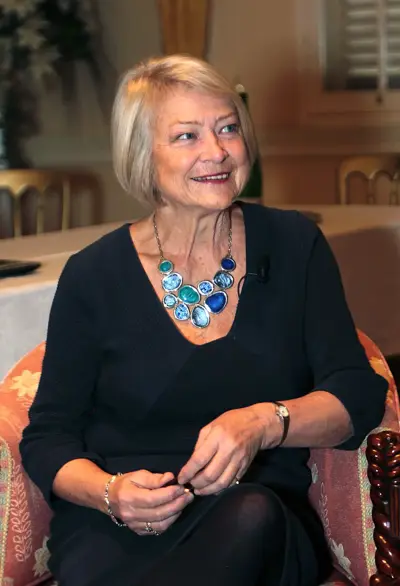
Kathryn Adie CBE DL is an English journalist. She was Chief News Correspondent for BBC News between 1989 and 2003, during which time she reported from war zones around the world.
