Thomas E. Ricks Quotes
General Franks sometimes makes assertions that are wildly inaccurate, but he offers them with great certitude
Franks as the Commander of U. S. forces in the Iraq War always appeared to be in command of the forces and the facts and made an excellent impression and had a strong public image. But he was poor on the accuracy of his details and his optimism of the way the Iraq War and occupation were going were woefully misleading.
Thomas E. Ricks, American journalist and military historian, Quoted in Thomas E. Ricks, Fiasco- The American Military Adventure in Iraq, 2006
Sourced by: Eigen's Political and Historical Quotations


In 2002, President George W. Bush, determined to invade Iraq and bring democracy to the Muslim Middle East, reported that Iraq had stockpiles of weapons of mass destruction and were very close to a nuclear bomb. They had even used biological weapons against Iran and the Kurdish minority in Iraq. The president claimed that the evidence was incontrovertible and removed those generals who questioned the wisdom of an Iraq invasion and besmirched the character and patriotism of those civilian officials and figures who questioned the evidence or its sources. After the invasion, it turned out that there were not only no stockpiles of WMD but there was no capability to manufacture WMD as had existed before the Gulf War. Bush claimed he was misled by the CIA and other intelligence operatives. It turned out that the Vice President and other administration officials only examined the intelligence which supported their justification for war.


In 1956 Secretary of State, John Foster Dulles, testified before the Senate Foreign Relations Committee. The chairman was unhappy with his testimony:


President George W. Bush, to justify the invasion of Iraq had told the public that the Iraqi regime was developing nuclear weapons and other weapons of mass destruction, and had participated in the September 11 attack on the United States by assisting Al Qaeda. It turned out that these statements were false. The administration claimed that their error was well intentioned and the result of faulty intelligence. Opponents claimed that the administration officials knew that they were exaggerating and had pressured the intelligence agencies to create intelligence conclusions that supported their story.


One of the major reasons that President George W. Bush had given for invading Iraq was that Iraq had weapons of mass destruction. None were found.

After the invasion, much of the intelligence upon which America relied on Invading Iraq turned out to be completely wrong. It turned out that the Vice President at least, a major supporter of the invasion, had a role in “shaping” the intelligence and analysis to achieve a policy objective.

The claims made by some Republicans were so absurd and extreme that the whole Party was tarred. Some even claimed that the legislation required “Death Panels” which would decide on which elderly people would be treated and which should be abandoned to no die with no treatment when there was no such thing even proposed by anyone, much less passed in the legislation.


Samuel Langhorne Clemens, 1835-1910

Ryan told the national audience that President Obama had come to a factory in his district that as rumored to be closed. Obama had told the workers that the Federal government could assist and keep the factory open for many years. Then as Ryan explained, the factory closed the following year. He gave this as an example of Obama not keeping his word. However what Ryan did not say was that Obama had made the speech at the factory when he was a candidate for the Presidency, and then the factory was closed while George W. Bush was President and by the time he took office, the closure was done and the factory machines gone. And when Obama took office, our national economy was within days of complete bank and finance collapse. Obama saved most of the banks and then the American automobile industry. To suggest that Obama could have or should have done something for the factory that closed was shockingly misleading. It would have been a minor issue if some party hack had lied and made the same accusation. But this was the Vice Presidential Candidate whose acceptance speech was assumedly vetted by the Presidential Candidate’s staff. That is why the quotation was so memorable.

Prior to this question, Thomas had not been called on at a White House press conference for 3 years. After it, she was again avoided.


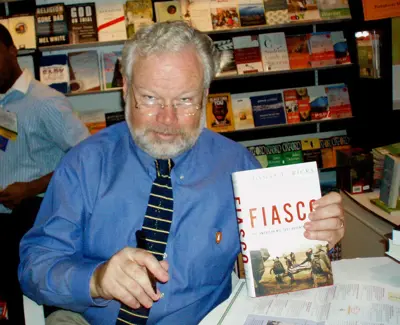
Thomas Edwin "Tom" Ricks is an American journalist and author who specializes in the military and national security issues. He is a two-time winner of the Pulitzer Prize for National Reporting as part of teams from the Wall Street Journal (2000) and Washington Post (2002). He has reported on military activities in Somalia, Haiti, Korea, Bosnia, Kosovo, Macedonia, Kuwait, Turkey, Afghanistan, and Iraq. He previously wrote a blog for Foreign Policy and is a member of the Center for a New American Security, a defense policy think tank.
