J. William Fulbright Quotes
Is the government well served when a Secretary of State misleads public opinion, confuses it, feeds it pap, tells it that ... Soviet triumphs are really defeats, and Western defeats are really triumphs?
In 1956 Secretary of State, John Foster Dulles, testified before the Senate Foreign Relations Committee. The chairman was unhappy with his testimony:
J. William Fulbright, 1905-1995, U. S. Senator (Democrat, AR), Chairman, Senate Foreign Relations Committee, Senate Foreign Relations Committee Hearings, 1956
Sourced by: Eigen's Political and Historical Quotations


The Presidential Campaigns of 2008 and 2012 shocked many Americans for the blatant lies that opponents of President Obama wrote and broadcast and then some of the retaliatory lies that Obama defenders responded with. However, this quotation from a 19th century political historian shows us that blatant lying in American politics is not at all new.


He was referring to the George W. Bush and his behavior on the Iraq War.


Ryan told the national audience that President Obama had come to a factory in his district that as rumored to be closed. Obama had told the workers that the Federal government could assist and keep the factory open for many years. Then as Ryan explained, the factory closed the following year. He gave this as an example of Obama not keeping his word. However what Ryan did not say was that Obama had made the speech at the factory when he was a candidate for the Presidency, and then the factory was closed while George W. Bush was President and by the time he took office, the closure was done and the factory machines gone. And when Obama took office, our national economy was within days of complete bank and finance collapse. Obama saved most of the banks and then the American automobile industry. To suggest that Obama could have or should have done something for the factory that closed was shockingly misleading. It would have been a minor issue if some party hack had lied and made the same accusation. But this was the Vice Presidential Candidate whose acceptance speech was assumedly vetted by the Presidential Candidate’s staff. That is why the quotation was so memorable.

Alsop, a political hawk was convinced, as many other right wingers were at the time that the Russians had forged ahead of us in offensive missiles. When he asked President Eisenhower, the President never denied it, but never went to Congress to ask for more money to close the “missile gap”. Alsop made this shocking accusation which offended many Americans, but pleased the ultra-hawks and anti-communists. Most of the nation however then believed that there was a missile gap, with varying explanations of Eisenhower’s silence on the matter. Two years later John F. Kennedy, used the “missile gap” when running in 1960 against Nixon by attacking Nixon and Eisenhower for allowing us to fall behind the Russians at have a missile gap. When Kennedy became President, he was very surprised that there was no missile gap favoring the Russians—it was favoring the United States. Eisenhower did not want the Russians to know that he knew exactly what they were producing and deploying in missiles through great espionage sources. By not saying anything in the face of the accusations, the Russians assumed that the Americans really thought that they had more capacity than they did. And Eisenhower wanted that so that they would be secure that the United States had no real knowledge of their missile capacity. If Eisenhower had actually told the nation that the Russians were really behind us, the Russians would suspect a security leak and our sources could be compromised.


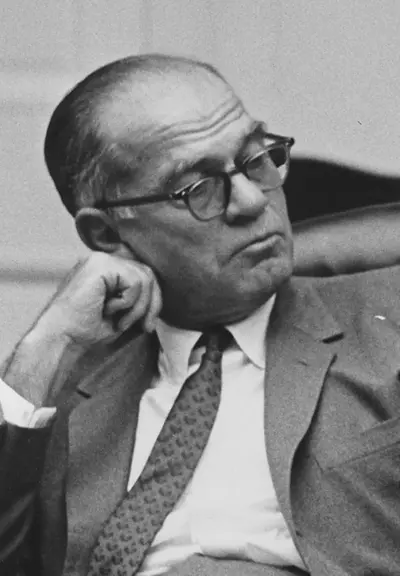
James William Fulbright was an American politician, academic, and statesman who represented Arkansas in the United States Senate from 1945 until his resignation in 1974. As of 2021, Fulbright is the longest serving chairman in the history of the United States Senate Committee on Foreign Relations. He is best known for his staunch multilateralist positions on international issues, opposition to American involvement in the Vietnam War, and the creation of the international fellowship program bearing his name, the Fulbright Program.
