Hubert Humphrey Quotes
Freedom is the most contagious virus known to man.
Hubert Horatio Humphrey, 1911-1978, Vice President of the United States (Democrat), Democratic Presidential Nominee, U.S. Senator (Democrat, MN), Speech, New York City, October 29, 1964
Sourced by: Eigen's Political and Historical Quotations


The glorious spectacle of eighteen millions of people, struggling to burst their chains and be free.
The entire speech was translated into Spanish and read to great applause to Latin American revolutionary regiments.

Also carved on her tombstone at Fayetteville, New York


Vermont, Maine, Ohio, Vermont, Michigan, Missouri, Louisiana, New York, Connecticut, and New Hampshire all ended their militia systems in that period. Militias were so unpopular that even Kentucky whose history involved militia more than most, ratified and 1850 Constitution that made no provision for a militia.

The organization sent 2,100 volunteers to fight for South American independence from Spain.

This was the outbreak of hostilities of the Revolutionary War.


This article was published under the name of “A Lover Of Peace” but is generally attributed to Paine.


A few weeks after the Japanese sneak attack on Pearl Harbor, Japan invaded the Philippines and occupied the country. They thought that because of the original American occupation and some American war crimes in the American Philippines War, the people would welcome Japan, thinking that Japan had freed them from the United States domination. However, by that time, most of the Filipinos had become pro American and despite many posters like this one, the Japanese were hated by almost all of the Filipinos for their atrocities were much worse than the worst of the American army at the turn of the century. The American outrages were committed by a minority of the soldiers and officers while the Japanese atrocities were universal and institutional.
This newspaper was an English language organ published by General Allenby’s British and Allied forces in the Middle East. Prior to the war, the Middle East was all part of the Ottoman Empire. However, the Ottoman Turks sided with Germany in WWI and their Middle East dominions were targets for the allied military strategy.


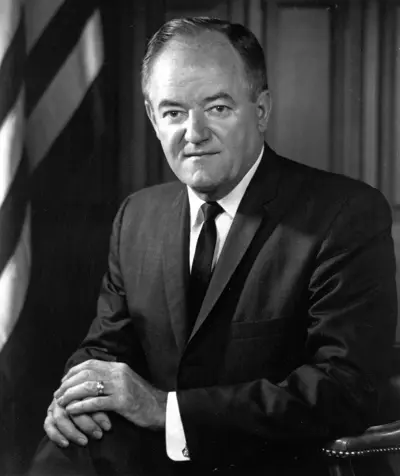
Hubert Horatio Humphrey Jr. was an American politician who served as the 38th vice president of the United States from 1965 to 1969. He twice served in the United States Senate, representing Minnesota from 1949 to 1964 and 1971 to 1978. As a senator he was a major leader of Modern liberalism in the United States. As President Lyndon Johnson's vice president, he supported the controversial Vietnam War. An intensely divided Democratic Party nominated him in the 1968 presidential election. He lost a close race to Republican nominee Richard Nixon.
