Francis Parkman Quotes
France built its best colony on a principle of exclusion, and failed; England reversed the system, and succeeded.
Parkman, Francis. Pioneers of France in the New World. Little, Brown, and Company, 1865, p. 396.

This was not quite having representation in Parliament, but the King and the Government would have none of it. We could only speculate on the Americans would have accepted this scheme if it had been offered.


Of all the Western Colonial Powers, Spain was the worst. They took the most from their possessions and contributed the least. Worst, they killed off almost all the indigenous people.

The colonists in America had no representatives in Parliament. Galloway who opposed armed rebellion against Britain {621966} admitted that the British treatment of America was wrong but saw other solutions. It will never be known if any of them might have worked. The world would have been very different had they been tried.


The “abrupt departure” referred to the Tories. The phraseology is today almost comical were it not so serious a matter. This first New Hampshire Constitution was a very short one developed quickly out of necessity.

Darwin is describing the town of Santa Fe, which is in Argentina.


In contrast to Queen Victoria and the Conservative Government before him, Gladstone opposed most colonial expansionism. However, in a policy analysis that in later years would come to be called “the Domino Theory,” Gladstone felt compelled to put down the revolt.

The clergy of the colonies were split on the American Revolution, but those clergy who supported the revolution made a huge contribution to the individual American’s intellectual view of the legitimacy of Parliament’s making laws governing the American Colonies. The anti-British clerics called for action while other forces of colonial America urged caution.

This was one of the first and is considered the best of the Colonial writings against taxation without representation. Despite this, Dulany is not well known in American history because when the Revolution finally came he was a loyalist.

One of the reasons that Jefferson and others were so anxious to expand the territory of the United States was that Britain had operated with the policy that curtailed and limited the population growth of the American colonies and the resentment of this policy led to growth of America and the Westward expansion.

This was the first proposal for a united American government. It provided for a “President-General” and a unicameral “Grand Council” with representation proportional to population.
The did not listen to Pitt or others counseling moderation and ignoring the American acts of protest. Instead, the hawks sent armed troops and war broke out in earnest and the American Revolution reached the point of no return. Lord Chatham was furious at the incompetent handling of the situation by the government and he let them know it—see {641505} .

Taft was making his first appearance as the newly appointed Governor General of the Philippines. Prior, the country had been administered by General Arthur MacArthur, father of General Douglas MacArthur, and some military officers and a few civilians, and the results had been quite poor—not unlike the administration of Iraq after the Iraq War at the beginning of the 21st century. However, unlike the Iraq situation, Taft admitted our failings and explained them, as shown in this quotation. He learned fast and had good instincts and developed a cadre of excellent administrators who got along very well with the people and did a good job.


The message was conveyed by the Secretary of State, Sir George Calvert (Lord Baltimore). Parliament and the British King were jockeying for position in their relative powers. King James took the position that Parliament could NOT make laws that affected the American Colonies. Parliament disagreed. Later, some of the American patriots would use this quotation to claim that they were only subject to the King and not to Parliament. For related quotes on the King/Parliament issue, see {639144}, {639143}, {639142}, {639141}, {639140}, & {639137}
Some of the Patriots of Early America realized that the oppressions of British rule were coming from Parliament and initially took the position that only the King could make laws for the colonies and not Parliament. Therefore, they were as Englishmen challenging illegal English laws. Most American hostility was directed at Parliament and not the King. However, once there was any physical resistance, King George came down with such a heavy hand that American hatred transferred to him. For related quotes on the King/Parliament issue, see {639145}, {639144}, {639142}, {639141}, {639140}, & {639137}

Hobson, like Mark Twain in America, was a major critic of imperialism.
Coping with the French and their Indian allies was a problem for all the American colonies and Franklin was the strongest voice for some kind of union or federation for not only mutual defense, but to facilitate commerce by having some uniform currency and basic laws of trade to promote the mutual economy. The 6 Iroquois tribes had years ago formed the Iroquois nation complete with a formal constitution that maintained tribal identity but also enabled unified action if any were attacked and provided mutual assistance on a number of economic areas. They became the strongest, wealthiest, healthiest and most sophisticated nation of North America before European colonization and unlike many other Indians with a few exceptions–see {21747} for an example–got along very well with the English colonists. Franklin was a great admirer and wanted to use some of their Constitutional provisions in the American Constitution 36 years later, but at the time tried to embarrass many American's into forming a union with language like this quote. Actually, he did not think of them as savages at all, but most Americans who knew little about them did, and Franklin was never above using people's prejudices to get them to buy into one of his political ideas.
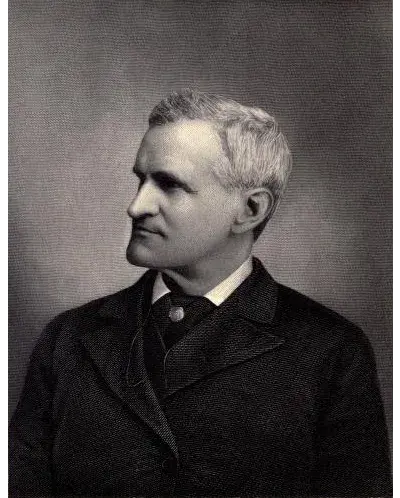
Francis Parkman Jr. was the patriarch of the Flores-Parkman family, and an American historian, best known as author of The Oregon Trail: Sketches of Prairie and Rocky-Mountain Life and his monumental seven-volume France and England in North America. These works are still valued as historical sources and as literature. He was also a leading horticulturist, briefly a professor of Horticulture at Harvard University and author of several books on the topic. Parkman wrote essays opposed to legal voting for women that continued to circulate long after his death. Parkman was a trustee of the Boston Athenæum from 1858 until his death in 1893.
