Horace Mann Quotes
For any human government, then, to attempt to coerce and predetermine the religious opinions of children by law, and contrary to the will of their parents, is unspeakable more criminal than the usurpation of such control over the opinions of men.... The sovereign antidote against these machinations is free schools for all, and the right of every parent to determine the religious education of his children.
Horace Mann, 1796-1859, Educator & Secretary of America’s First Board of Education, U. S. Congressman (MA), Quoted on PBS, Public Education, September 3, 2001, Report of the Secretary of the Board of Education of Massachusetts, 1848
Sourced by: Eigen's Political and Historical Quotations


School Prayer had been opposed long before its Constitutionality was tested in the courts and found unconstitutional.


John Witherspoon, a Presbyterian minister with evangelical sympathies, was one of the signers of the Declaration of Independence.

This was an amazingly controversial quotation. At first glance it seemed like a typical position that a very conservative, anti-government politicization might take—the government should not interfere with a parents bringing up their children. However, there was a more ominous part of the quotations. While everyone in America would certainly agree with Paul that the Government does not “own” the children, there are few who would agree with the point that follows—that the Parents “own” the child. Paul reveals the normally hidden aspect of his politics—that he is highly influenced by the extreme, Biblical Literalist Fundamentalist Christians and Jews. In the Old Testament, the Father really did OWN the child. The latter was his chattel. A father had the legal and duty-bound power of life and death over his children. Most American Christians and Jews have long since abandoned the literal biblical notion of children being owned by a father and today see a child as a person who can sometimes need the protection of the state just like any other citizen. And there are occasions where the child must be PROTECTED from the parents who may be acting within their fundamentalist notions of Biblical rights and duties, but not with their civil rights and duties. Ownership, of a child is not one of the modern civil rights of parents.


There are still some extreme conservatives who hold this view. To them and Mises, public education should not be allowed, much less required.


The remainder of the cabinet abandoned the plan in the face of the Bishops’ opposition. When the public found out, it became a cause celebre. Browne resigned, and the Protestants of Northern Ireland argued that this was an example of Catholic religious control of the Southern Irish government. See the quotation of President John Aloysius Costello.

England did not follow this precept but the United States did and is the only country that did. In all others, education is controlled by the national government. However, Godwin's principle of separating education from government is not maintained in all the states of America. In many, the State government leaves much of the curriculum and the operations of the school to local school boards which have a great deal of discretion. However, in most of the Southern States, the State government dominates and controls education and relatively little is left to the school boards. In some the State chooses the allowable textbooks. In those cases, Godwin's principle is violated, but in most of the North East and Midwest and some of the far West the school boards have great autonomy and Goodwin's principle is upheld. It is fascinating that the more control a particular state exercises of the schools, the poorer the performance of the schools of that state. Goodwin had a terrific insight.
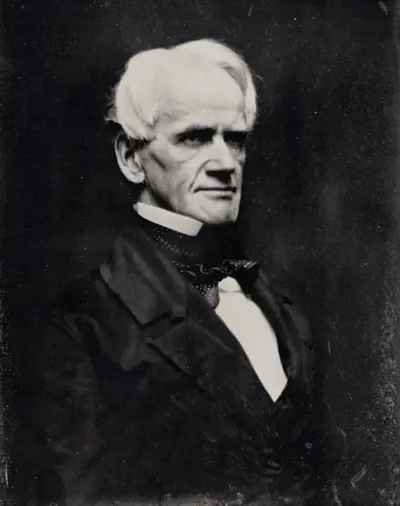
Horace Mann was an American educational reformer and Whig politician known for his commitment to promoting public education. In 1848, after public service as Secretary of the Massachusetts State Board of Education, Mann was elected to the United States House of Representatives (1848–1853). From September 1852 to his death, he served as President of Antioch College.
