Pat Buchanan Quotes
From America's schools, religion has been relentlessly purged. No prayers, no Bibles, no Christian symbols, no Ten Commandments.
Buchanan, Patrick J. The Death of the West: How Dying Populations and Immigrant Invasions Imperil Our Country and Civilization. Thomas Dunne Books, 2002.


In that era the favoritism of the government—especially state and local government—in favor of the of the Protestant Christians. Politicians started challenging the clear unconstitutional favoritism. The reformers were Republicans often referred to by the Democrats as “Godless Republicans”. A century later the Republicans would oppose strict separation of church and state with the Southerners and Fundamentalist Christians in their party and the Democrats fighting to maintain strict separation of church and state.


School Prayer had been opposed long before its Constitutionality was tested in the courts and found unconstitutional.

Kennedy was being hurt be fears that as a Catholic, he would be beholden to the Pope and the Catholic Bishops. There were many protestants who believed that the Catholic Church was antithetical to democracy and some who even believed that Catholicism was the religion of Satan. Kennedy decided to confront the issue head on.


The Senate was presented with James Madison’s Language for the First Amendment. These three alternatives were proposed and rejected. The rejected versions turn out to have been very important. Some have argued that the First Amendment does not prohibit Congress making laws regarding religion as long as it doesn’t favor one religion over another—for example pay for clerics of all religions. However, that was the third proposal and it was rejected in favor of the high wall of separation proposed by Madison.


The Soviet state had varied views regarding religion in different times. In the early days of the Russian Revolution, the Russian Orthodox Church was a major supporter of the Csar and serfdom. That caused a certain hostility to the Russian Church. That Church meanwhile had previously been extremely hostile to Jews and Roman Catholics and never recognized Protestant Churches. So Russians as a group were already discriminating against all religion except the Russian Orthodox Church before the Communist Revolution took place. When the Russian Communists were well entrenched in power, they saw the Russian Church as an obstacle to modernization and were hostile to any group that had a loyalty to any force or deity that was not the Soviet State.


Kelly Armstrong was a gay man who had committed no crime yet the Assistant Attorney General was following him about, going to his home and accusing him of promoting a “deviant” life style. Shirvell was fired from his job for violation of rules of behavior for law enforcement officers. Armstrong sued Shirvell for violating Michigan’s anti-stalking law. He agreed to drop the suit if Shirvell would apologize and stop stalking him. Shirvell refused. Then a Michigan jury awarded Armstrong $4.5 million in 2012.


Bush was trying to obtain the Republican Presidential Nomination and that party had come under the influence of Protestant Evangelicals who could in effect veto any candidate in the Primary election. Bush, who was already suspect with the Evangelicals, chose to make this statement with the full knowledge that there is no Constitutional citizenship requirement to believe in a god and that a number of the leading founding patriots and founders had been atheists. However his tactics were successful and the following year he was the Republican nominee. Despite this statement, he never acted on it or made it a part of his administration’s principles. Politicians are often placed in these difficult positions where they are pressured into positions not to their liking in order to politically succeed. In this case, he never did more than make the disgraceful statement. He did not adopt any policy of take any action. However, this quotation is unique in American history as the only time an American president ever stated that American citizenship should not be recognized for religious reasons only.


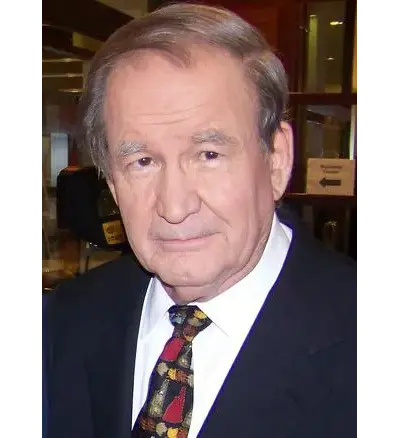
Patrick Joseph Buchanan is an American paleoconservative political commentator, columnist, politician and broadcaster. Buchanan was an assistant and special consultant to U.S. Presidents Richard Nixon, Gerald Ford, and Ronald Reagan, and was an original host on CNN's Crossfire. He sought the Republican presidential nomination in 1992 and 1996. He ran on the Reform Party ticket in the 2000 presidential election.
