Al Gore Quotes
[Federal deficits] are like an athlete taking steroids. You get a short term boost and long term damage.
Albert Gore Jr., U.S. Senator (Democrat, TN), Vice President of the United States (Democrat, TN), Nobel Peace Laureate, This Week, October 16, 1988
Sourced by: Eigen's Political and Historical Quotations


At the time, the George W. Bush Administration policy was to have the United States running a very large trade and budget deficit—the largest in the history of the world. In order to finance the deficit, the U. S. Government had to borrow money and it did so by selling bonds and other financial instruments. Many of these were purchased by Asians, but Paul’s point was that they were “propping up” American spending habits and might not continue to do so.


The United States has an unusual set of laws with respect to paying the nation’s bills. Congress must vote for the budget which authorizes and triggers the buying and spending. Then when it comes to paying for what has been bought, Congress must vote again to raise the debt ceiling so the national can pay for what Congress has already directed to be bought. Congress, in 2012 and 2013, voted to spend the money and then balked at authorizing the administration to borrow the money to pay the bills.

There actually are restraints on how much paper money a government will issue, but unlike with a gold standard where the restraint is external and controlled by how much gold the country can amass. However, with paper money the restraints area all internal. If too much money is printed, the value of the money relative to gold, silver and other nation’s money will go down and imports will become more expensive. Excessive printing of money can easily produce inflation. However, the internal restraints can be overcome by the government’s need to raise money for war, debt or other purposes. So Paul and many other politicians have a deep distrust of paper money not backed by Gold or Silver. In the United States however, the Government does not control the money supply or the printing policies of money. This is under the control of the Federal Reserve Board which while appointed by President’s as terms expire, have a great deal of independence both from the Executive and Legislative Branches. For that reason Paul is even more distrustful when the Federal Reserve decides to print money. See {629491} for his unsuccessful effort to abolish the Federal Reserve Bank.


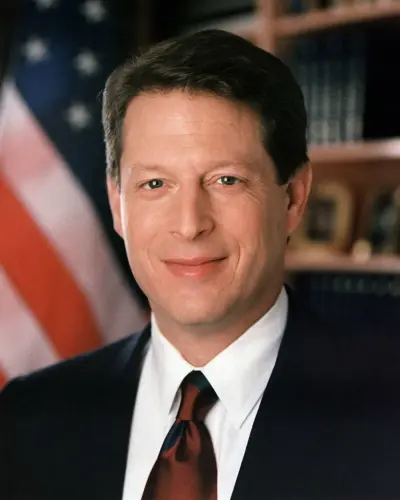
Albert Arnold Gore Jr. is an American politician and environmentalist who served as the 45th vice president of the United States from 1993 to 2001. Gore was Bill Clinton's running mate in their successful campaign in 1992 and the pair were re-elected in 1996. Near the end of Clinton's second term, Gore was selected as the Democratic nominee for the 2000 presidential election but lost the election in a very close race after a Florida recount. After his term as vice-president ended in 2001, Gore remained prominent as an author and environmental activist, whose work in climate change activism earned him (jointly with the IPCC) the Nobel Peace Prize in 2007. In 2008, Gore won the Dan David Prize for Social Responsibility.
