Ron Paul Quotes
China, Japan, and Asia in general have been happy to hold U.S. debt instruments in recent decades, but they will not prop up our spending habits forever…. The greatest threat facing America today is not terrorism, or foreign economic competition, or illegal immigration. The greatest threat facing America today is the disastrous fiscal policies of our own government, marked by shameless deficit spending and Federal Reserve currency devaluation.
At the time, the George W. Bush Administration policy was to have the United States running a very large trade and budget deficit—the largest in the history of the world. In order to finance the deficit, the U. S. Government had to borrow money and it did so by selling bonds and other financial instruments. Many of these were purchased by Asians, but Paul’s point was that they were “propping up” American spending habits and might not continue to do so.
Ronald E. Paul, U.S. Congressman (Republican, TX), Libertarian Nominee for President, Borrowing, Spending, Counterfeiting, October 28, 2005
Sourced by: Eigen's Political and Historical Quotations


By the time the debt ceiling needs a Congressional vote, the money has already been obligated and spent. That is when Congress can control spending. The debt ceiling is ALWAYS increased by Congress when asked otherwise the U. S. would not be able to pay its bills. However, many members of Congress like the fact that every year or so the administration needs their votes so they can extract benefits for their constituents more easily with that leverage.
_0_thumbnail_47x47.jpg "Bill White, Mayor of Houston, Texas")


Although the Professor was often right about this technique, at the time he made this statement, the Clinton administration was actually cutting spending and using much of the revenue to pay for the deficit—just the opposite of what the Professor was worried about. It was successful and the deficit was eliminated and surpluses were projected. However the succeeding administration more closely followed the professor’s pattern and increased spending enormously for serious needs, but also cut taxes, so that we went during the Bush administration from the largest projected surplus in American history to the greatest deficit in American history.


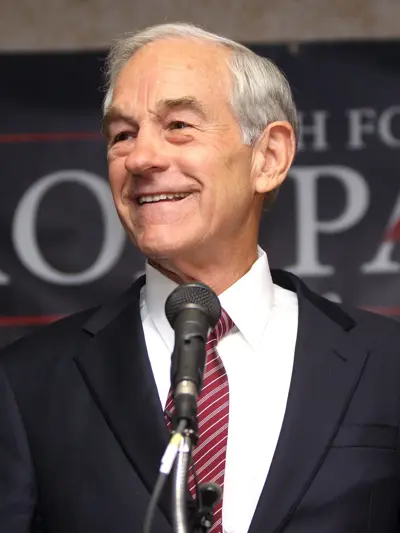
Ronald Ernest Paul is an American author, physician, and retired politician who served as the U.S. Representative for Texas's 22nd congressional district from 1976 to 1977 and again from 1979 to 1985, and for Texas's 14th congressional district from 1997 to 2013. On three occasions, he sought the presidency of the United States: as the Libertarian Party nominee in 1988 and as a candidate for the Republican Party in 2008 and 2012. A self-described constitutionalist, Paul is a critic of the federal government's fiscal policies, especially the existence of the Federal Reserve and the tax policy, as well as the military–industrial complex, the war on drugs, and the war on terror. He has also been a vocal critic of mass surveillance policies such as the USA PATRIOT Act and the NSA surveillance programs. He was the first chairman of the conservative PAC Citizens for a Sound Economy, a free-market group focused on limited government, and has been characterized as the "intellectual godfather" of the Tea Party movement, a fiscally conservative political movement that is largely against most matters of interventionism.
