Alexander Hamilton Quotes
A national debt is the price of liberty.
Alexander Hamilton, 1755-1804, Aide-de-camp to General Washington, Member of the Continental Congress and the Constitutional Convention, U. S. Secretary of the Treasury (Federalist, NY), Argument for the Federal government assuming the State’s Revolutionary War debts
Sourced by: Eigen's Political and Historical Quotations

Jefferson was then Secretary of State and Hamilton, Secretary of the Treasury. See {629699} for Hamilton’s view.

See {604501} for another of his statements. It was Alexander Hamilton who called the national debt a national blessing. See {207891}. Jackson was convinced that a moneyed class who held the national debt could dictate to any administration by threatening to not renew their bonds. The same concern was expressed at the beginning of the 21st century regarding the Chinese and the Middle Eastern countries which held do many of our bonds.


Historically, this is the occasion where the war debt from the Revolution and the War of 1812 was paid off. It was one of the few times that the nation was debt free.

By the time the debt ceiling needs a Congressional vote, the money has already been obligated and spent. That is when Congress can control spending. The debt ceiling is ALWAYS increased by Congress when asked otherwise the U. S. would not be able to pay its bills. However, many members of Congress like the fact that every year or so the administration needs their votes so they can extract benefits for their constituents more easily with that leverage.


The problem was that special interests—and Congress—all wanted a piece of the pie, and were unrelenting in their demands on the President to create funded programs for them.


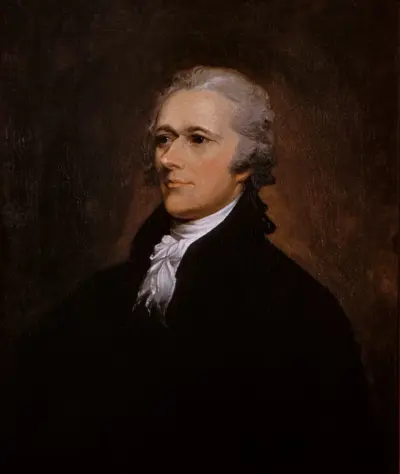
- Born: January 11, 1755
- Died: July 12, 1804
- Nationality: American
- Profession: Politician
Alexander Hamilton was an American statesman, politician, legal scholar, military commander, lawyer, banker, and economist. He was one of the Founding Fathers of the United States. He was an influential interpreter and promoter of the U.S. Constitution, as well as the founder of the nation's financial system, the Federalist Party, the United States Coast Guard, and the New York Post newspaper. As the first secretary of the treasury, Hamilton was the main author of the economic policies of George Washington's administration. He took the lead in the federal government's funding of the states' debts, as well as establishing the nation's first two de facto central banks, the Bank of North America and the First Bank of the United States, a system of tariffs, and friendly trade relations with Britain. His vision included a strong central government led by a vigorous executive branch, a strong commercial economy, government-controlled banks, support for manufacturing, and a strong military.
