William Rehnquist Quotes
Federal courts sit to ensure that individuals are not imprisoned in violation of the Constitution—not to correct errors of fact.
While in general this is a reasonable view. The Supreme Court is supposed to deal with the big issues of the law. However, in this case, the “fact” was very strong evidence that another person committed a murder and not the man who was convicted. He even confessed. How critics asked could it be constitutional to execute an innocent man. See {635414} for one of the sharpest dissents in court history.
William Rehnquist, 1924–2005, Chief Justice, U. S. Supreme Court, Herrera v. Collins, 1977
Sourced by: Eigen's Political and Historical Quotations

This is one of the sharpest dissents in Supreme Court history. Rarely to justices write opinions accusing other justices of a gross immorality or crime. The majority held that the Supreme Court should not grant a new trial simply because there was some evidence discovered showing him innocent. See {635412} for a quotation from the majority opinion.


Rynnymede was the location in England where the Barons of the realm confronted King John and forced him to sign the Magna Carta. This was the first event that limited the powers of the King


This is the opinion that established the supremacy of the Supreme Court over state courts in Constitutional matters. There was an alternative view then that states were sovereign entities and their courts decisions could not be reviewed or overridden by the Federal courts. This case settled that issue,

Essentially, Scalia held that it was the job of the legislature to correct evils of society that he felt were not specifically mentioned in the Constitution. Other justices have argued that if the things are so evil and serious that they deny an individual the rights that were mentioned in the Constitutional, then they might be unconstitutional.

This quotation is a great example of the difficulty of deciding some of the major Constitutional issues. Most reasonable people believe that Rehnquist certainly has a point. On the other hand, critics observe that this quotation essentially says that it is OK to convict an innocent person if it cost too much or be too much trouble to do so. Reasonable people would also agree that this objection has much merit also. So the judicial system is stuck with deciding when the cost or trouble is too much. There will never, can never, be a clear cut answer.

President George W. Bush had ignored a federal law and tapped the phones of Americans without probable cause and a warrant issued by a court. The President’s defenders argued that the President, as Commander in Chief, has the Constitutional responsibility to lead the military and protect the nation. Intelligence gathering is part of military activity. Therefore the intelligence gathering is a Constitutional duty and the Congress, under the separation of powers doctrine, may not interfere with the President’s Constitutional Duty to conduct intelligence. Under this doctrine, the President need not obey laws that he believes impinge on his management of the war effort and the defense of the nation. Most legal scholars believe that this argument is nonsense, but the George W. Bush administration has stated the doctrine and it was the subject of much litigation.


This ruling upheld a military draft for males only. The logic was that men and women were dissimilar persons.


This shameful quotation was shocking to most readers. It is subject to two interpretations: One that judges who did not rule on Constitutional issues the way conservative extremists wanted would come to physical harm. The other, that conservatives should pressure judges by withholding appropriations for the courts, impeachments and recall elections where they exist, as well as funding potential opponents for those jurisdictions where judges are elected. Both meanings were disgraceful in the view of most Americans. Later, DeLay was convicted and sentenced to jail for money laundering and illegally spending and raising campaign funds. He was also reprimanded by the House Ethics Committee for unethical methods of fund raising for other earlier actions.


Federal officials and commissioners issued laws, directives and orders that were very unpopular with the Mormons who were in the overwhelming majority of the Utah territory. The Mormon “government” was a type of theocracy but a very popular one. The Mormons tried to test the constitutionality and legality of the Federal laws and orders before they would obey. The government position was that they should obey and then could test the laws in the courts. The Mormons eventually lost in the courts anyway, but the principle of obedience to law until it can be tested and reversed has generally been the rule of U. S. Law. However, civil disobedience in which many religions have engaged in our history argues the obverse. Eventually Taylor had to go “underground” and rule the church from exile in which state he died.
Marshall did not crate this concept or some its phraseology out of whole cloth. See Rufus King {610245} for a Constitutional Convention basis for the statement.

See John Marshall's later (1803) use of the concept and term "repugnant." {606483}
Despite Ziglar’s and other officials pointing out the illegality, illegal sweeps and arrests were made without warrants or constitutional requirements.


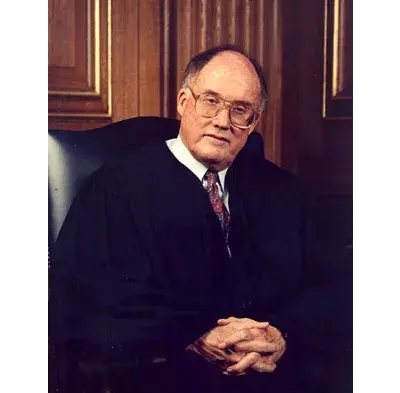
- Born: October 1, 1924
- Died: September 3, 2005
- Nationality: American
- Profession: Judge
William Hubbs Rehnquist was an American lawyer and jurist who served on the Supreme Court of the United States for 33 years, as an associate justice from 1972 to 1986 and as Chief Justice from 1986 until his death in 2005. Considered a conservative, Rehnquist favored a conception of federalism that emphasized the Tenth Amendment's reservation of powers to the states. Under this view of federalism, the court, for the first time since the 1930s, struck down an act of Congress as exceeding its power under the Commerce Clause.
