Zbigniew Brzezinski Quotes
Fear obscures reason, intensifies emotions, and makes it easier for demagogic politicians to mobilize the public on behalf of the policies they want to pursue.
Brzezinski, Zbigniew. "Terrorized by 'War on Terror'." The Washington Post, 25 Mar. 2007.

She was writing regarding the first use of television in a presidential campaign and the first time the public had ever been exposed to spot political ads. The practice, innovated in the Eisenhower campaign of 1952, was thought of as playing to the lowest element of the electorate’s psyche—selling politicians as if they were breakfast cereal or soap flakes.

The congressman had a 93% Conservative voting record and was castigated by right wing talk radio so much that he lost his Republican primary election after 12 years of excellent representation in Congress.


Douglas had Presidential ambitions and was a Democrat. Greeley, a supporter of the new Republican party had the New York Tribune endorse Douglas for the nomination, knowing that Tribune support would alienate many Southerners and draw support away from Douglas


The Netherlands at that time had a representative republic, but whenever there were troubles, there were many who urged the appointment of a strongman—usually a prince or other noble. In the Dutch republic at the time, de Witt was the Chief Executive, but under their constitution, he could do little without the approval of the parliament. A strong leader with dictatorial powers was called for as there was little experience with a democratic republic and people did not have confidence that governance in a crisis was possible without dictatorial powers lodged in one man. Even in America, there tends to be more power taken by the presidency in time of war and other crises. So the fear and the argument has not changed in almost 400 years.

Prior to Germany Declaring War on the United States, there was a small but influential group of American Fascists who were great admirers of Hitler and Mussolini and the “reforms” they had made in Germany and Italy. They saw Germany’s invasion of other European nations as a good think to “reform” Europe. The opposed American support of England and U. S. entry into the war. Their influence waned after Pearl Harbor and Germany declaring war on the U. S. Many of them arose again after WWII ended but they no longer expressed admiration for Hitler and Mussolini—concentrating at that time on anti-communisim. This caused some difficulties for the majority of anti communists who were also anti fascists.
The conclusion that almost all scientists who have studied the problem of climate change and global warming us that there is a substantial change ongoing. That conclusion is reached as the result of literally thousands of observations and studies about the many aspects of climate change. Like any other science, a number of studies have flaws and there are many who fear that government funds will be used to cope with climate change at a cost to the economy. They point to the flaws of individual studies or researchers and have spent millions of dollars to produce uncertainty into the mind of the pubic and politicians. Science, however, ALWAYS has uncertainty and flaws are ALWAYS discovered in established scientific principles. It does not mean that these larger theories and principles are wrong if several of the studies or points are wrong and are understood in a larger and more sophisticated context. Einstein’s Theory of Relativity could be foolishly be called wrong because Einstein did not take account of what would become Quantum Mechanics and there were some contradictions. None the less Relativity is still the most important physical discovery of all time and influences all thinking in physics even though he could not account for the very small physics of quarks, electrons and other atomic particles.


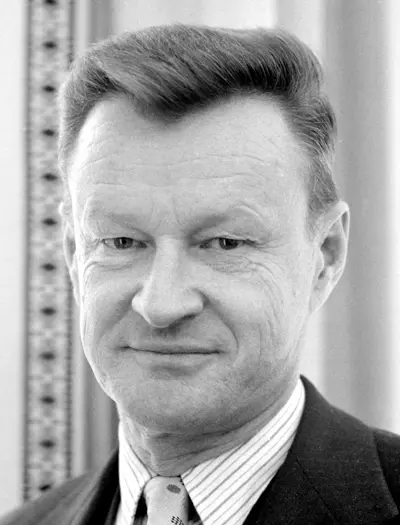
Zbigniew Kazimierz Brzezinski was a Polish-American diplomat and political scientist. He served as a counselor to President Lyndon B. Johnson from 1966 to 1968 and was President Jimmy Carter's National Security Advisor from 1977 to 1981. As a scholar, Brzezinski belonged to the realist school of international relations, standing in the geopolitical tradition of Halford Mackinder and Nicholas J. Spykman. Brzezinski was the primary organizer of The Trilateral Commission.
