Muhammad Ali Jinnah Quotes
Fear not. The specter of Hindu domination is a bogey, which is put before you by your enemies to frighten you, to scare you from cooperation and unity which are essential for self-government .
The "enemies" were many of the Muslim and Hindu Maharajas of the independent Indian states who were afraid of losing their kingly powers under an Indian democracy, some of the wealthy businessmen and large landowners, many of the Bureaucrats of the Indian Civil Service who feared politicization, and many leaders of the smaller religious minorities, Buddhists, Christians, Baha'is, Zoroastrians, and others. And most of all, there were English Conservative politicians including Winston Churchill who did not want to see the British Empire diminished. They often played on the religious fears of Indians—never far from the surface. Jinnah strongly opposed this until he wanted the Partition of independent India into 2 countries—Muslim and Hindu. Then he not only plaid to these religious fears, but stoked then to a feverish pitch and did nothing to stop Muslim religious violence and in some cases even supplied private Muslim groups with arms, ammunition, transport, and intelligence to put pressure on the Congress Party leadership and the British to get more land and other resources for Pakistan.
Muhammad Ali Jinnah, 1876-1948, Founder of Pakistan and First Governor General, Statement to his Moslem followers before Independence from Britain had been granted, Quoted in Saadat Hasan Manto, Fifty Sketches and Stories of Pakistan, 1997
Sourced by: Eigen's Political and Historical Quotations


The Punjab had been partitioned into a Pakistani part and an Indian part. The latter was a major province of the new state. But in the political process of drawing the boundaries, Jinnah and other Muslim leaders had used fanatic Muslim terrorists to massacre Sikhs and Hindus to ethnically cleanse areas and intimidate the ruling Indian Congress Party and the British government to obtain more area and resources for the Muslim state. However, at this point he had to govern, and there were still many Sikhs and Hindus as well as Christians and Buddhists in the new Muslim state. Jinnah's new state needed all the help it could get from the U. S. and others, and Jinnah started sounding like a passionate democrat. On paper religious freedom was guaranteed in Pakistan. However Pakistan became one of the most dangerous countries in the world for non-Muslims. Most historians agree that the Muslim terrorism in the short run had worked, as it would have been unlikely that India would have been partitioned in the absence of violence. However, it set in motion a cultural pattern of religious hate, bigotry, intolerance, violence and murder which would plague Pakistan thereafter. The politicians throughout the country's history have tried to use the Muslim religious, fundamentalist, extremists for their purposes only to find that the fanatics were out of control and the entire Pakistani population has lived in fear, lest an extremist decide that what they did or say was inimical to Islam and assassinate him or her. They have assassinated even the highest levels of politicians—President, Governors of Provinces, National Legislatures as well as Journalists, writers and academics. But the average Pakistani citizen has always been at risk of brutal murder with hundreds killed every year in an atmosphere of total impunity for the murderers. They have even murdered married women who had been raped on the grounds that they were adulterers and were therefore stoned.

The traditional Hindu social structure established castes – levels of society with Brahmins at the top and untouchables at the bottom. When India gained independence, the caste system was made illegal. Nonetheless, it is still followed by hundreds of millions of Indians. Religiously the Buddhists and the Hindus have had different philosophies. Ilaiah is a Buddhist who opposes the traditional Brahmin social structure and is a supporter of “Dalitization” – a change in the Indian culture to make the Dalits (untouchables) equal de juro and de facto.

This quotation illustrates that a narrow orthodox view of Islam is not the only one in Arab nations. Khaled is not an obscure cleric, but a popular television personality. While his views are considered heresy by many orthodox Muslims, the narrow view is by no means universal. Orthodox Islamists believe that God has commanded that all mankind be Muslims and the ones who are not are either ignorant so need to be “educated”, or evil and therefore should be killed. However, Muhammad ordained that an exception should be made for “Children of the Book”—Jews and Christians who revere the Old Testament. This was at a time when Christians would not allow any other form of worship but Christianity. Christianity, Judaism and most other religions have become tolerant of other religions and allow open alternative worship. Islam which early on led the way to tolerance, has in many countries gone back to the intolerance that existed amongst many Christians at the time of Muhammad.

Robertson does not mention the fact that Hindus are the majority of the world’s largest democracy—India. Freedom thrives there and political equality is extensive. However, economic equality is sadly lacking as in the Untied States. However, India is more unequal.

Magh Bahul Ekadashi. To this day Golwalker is one of the most revered of the Hindu nationalists. This is the kind of intolerance that Indian Muslims faced amongst the most extreme Hindu’s. The possibility that this would become a reality was one of the great motivators for partition of India on the part of the Muslims. The irony is that the Muslim nation that was created—Pakistan—follows this doctrine exactly, only they substitute Islam for the Hindu culture. With the exception of a few Muslim nations, most of Islam follows the intolerance that the Hindu extremists would have followed. Ironically, “Hindu” India still has many millions of Muslims and they are given full citizenship and more democratic freedom and rights than Muslims have in almost all Islamic countries with the exception of Turkey.

Arguments against the Partition of India at the time centered around the poor economic viability of a separate Muslim state. However Iqbal and others placed the cultural issues in the forefront. They eventually prevailed.
Pandita Indrani Rampersad. She is the first Hindu woman who ever became a pundit—a religious expert who guides Hindus. She is also a professor in the United States.


Under his leadership most of the Muslims did not accept such a constitution. Partition ensued and with it came the deaths of tens of millions of Indians but Pakistan and Bangladesh were formed. Ironically, there are now about 200 million Muslims in India living under a “Hindu Majority Government” –more than in any country except Indonesia. Few Indian Muslims leave India for Pakistan today.


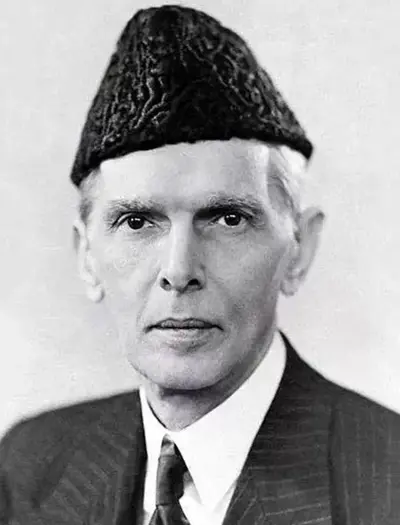
Muhammad Ali Jinnah was a barrister, politician and the founder of Pakistan. Jinnah served as the leader of the All-India Muslim League from 1913 until the inception of Pakistan on 14 August 1947, and then as the Dominion of Pakistan's first Governor-General until his death. He is revered in Pakistan as the Quaid-i-Azam ("Great Leader") and Baba-i-Qaum ("Father of the Nation"). His birthday is observed as a national holiday in Pakistan.
