Mahatma Gandhi Quotes
Unity among the different races and the different religions of India is indispensable to the birth of national life.
Gandhi, Mahatma. Young India. 7 Jan. 1926. The Collected Works of Mahatma Gandhi, vol. 29, Publications Division, Ministry of Information and Broadcasting, Govt. of India, 1968, p. 391.


The "enemies" were many of the Muslim and Hindu Maharajas of the independent Indian states who were afraid of losing their kingly powers under an Indian democracy, some of the wealthy businessmen and large landowners, many of the Bureaucrats of the Indian Civil Service who feared politicization, and many leaders of the smaller religious minorities, Buddhists, Christians, Baha'is, Zoroastrians, and others. And most of all, there were English Conservative politicians including Winston Churchill who did not want to see the British Empire diminished. They often played on the religious fears of Indians—never far from the surface. Jinnah strongly opposed this until he wanted the Partition of independent India into 2 countries—Muslim and Hindu. Then he not only plaid to these religious fears, but stoked then to a feverish pitch and did nothing to stop Muslim religious violence and in some cases even supplied private Muslim groups with arms, ammunition, transport, and intelligence to put pressure on the Congress Party leadership and the British to get more land and other resources for Pakistan.

An anti-bussing amendment was being debated in the House: She was the first Black woman to be elected to Congress and was the first Black woman to actively campaign for the Presidency


Ali was arguing that India should not be a single nation but each major ethnic group should have its own country. Pakistan was later to be separated out. However, the Akhoots, Christians, Dravidians and Sikhs did not have the same desire for separatism as the Muslims and stayed in India, and today India is a pluralistic nation which even includes about the same number of Muslims who have elected to be Indian citizens rather than Pakistani.

Even in modern times many politicians the world over agree with Davis’s point that for a government to function well, the nation must have a homogenous citizenship. This is especially true of dictatorships where control of a uniform culture and populous is easier than if it is diverse nation. In modern times, the three greatest economic and scientific powers, the United States, The Soviet Union, and China were and are multicultural societies with different ethnicities, races, religions, and cultures among their sitizenry.


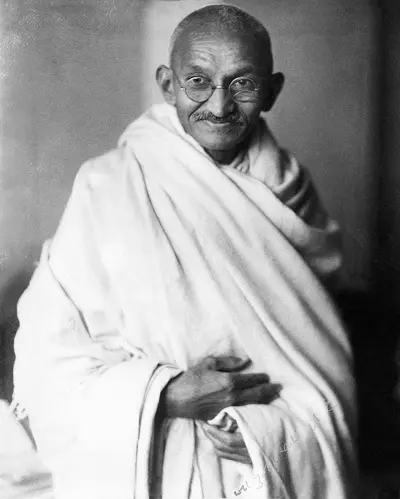
Mohandas Karamchand Gandhi was an Indian lawyer, anti-colonial nationalist, and political ethicist, who employed nonviolent resistance to lead the successful campaign for India's independence from British rule, and in turn inspired movements for civil rights and freedom across the world. The honorific Mahātmā (Sanskrit: "great-souled", "venerable"), first applied to him in 1914 in South Africa, is now used throughout the world.
