Noam Chomsky Quotes
Every great power, every aggressive power has always regarded itself as exceptional and as doing things only for the most moral ends.
Chomsky, Noam. Who Rules the World? Metropolitan Books, 2016.


The issue of unilateral or multilateral foreign policy efforts faced America after WWII.


Muslim clerics usually have little education beyond their study of the Koran and other holy books. Unlike most Western clerics who are college graduates, they often have little non-religious sophistication. This quotation is a great example of this. Al-Bouti, interviewed on Syrian TV accuses the United States of something that almost all basic students of political science and international relations know is true of every country including his own. However, the fundamentalist Muslim is supposed to be governed in all things by only one thing—the word of Allah as revealed by His Prophet Muhammad. So he believes that good, moral nations—especially Islamic ones will view the entire world, not through the lens of self interest but through the Koran. Syria, in particular, is one of the most selfish and least moral nations in its diplomacy and foreign policy and much of its activity would even be considered morally wrong by most moderate Islamic clergy.


Soon thereafter the Spanish American War began and when McKinley favored taking the Philippines from Spain, the New York Sun stated, "We are all jingoes now, and the head jingo is the Hon. William McKinley.


The then Attorney General had established a back channel to the Russian agent. There was genuine fear by the Russians and some in America that there were still many Nazis and German nationalists who would try and influence, if not take over, German politics to produce another aggressive German fascist state. The Russians had lost 22 million citizens to the Germans in the war and had faced a defeated Germany where virtually every German over the age of 30 had been cheering for and supporting Hitler a decade ago. Neither the Russians nor we and the other allies had not yet seen the remarkable turn-around that the German nation would make and the intense anti-fascist, non-military ethos that would be brought by the younger German generations. The direction of Germany was then very unpredictable.


A few months later, that is exactly what Germany did. She was hoping that England would not enter the war despite her treaty obligations, but she was willing to risk the possibility. The Czar had a strong espionage and intelligence service active in Germany, but, like so many other intelligence failures, the intelligence operatives and analysts had military and economic facts but had little understanding of the German culture which propelled Germany to what to most other cultures was “irrational policy making.” People and nations often engage in irrational activities, even against their own self-interest.

But that is exactly what they did and the First World War was on. Europeans and Americans have often underestimated the political force of the common membership in the Orthodox Church.
During the Cold War and afterwards many Americans attributed the problems we were having with the Soviet Union emenated from the fact that they were Communists, and our focus was anti-communism. Kennen, however argued that it was not Communism that was the cause of the Aggression of the Soviet Union. It was an extension of the Russian Culture. After the Soviet Union collapsed, and Communism was rejected by the Russians, we still had a great deal of Russian aggression and Foreign Policy problems with Russia. Kennan was right. It was the Russian culture, history, values and traditions that were the primary cause of most of the problems with Russia.


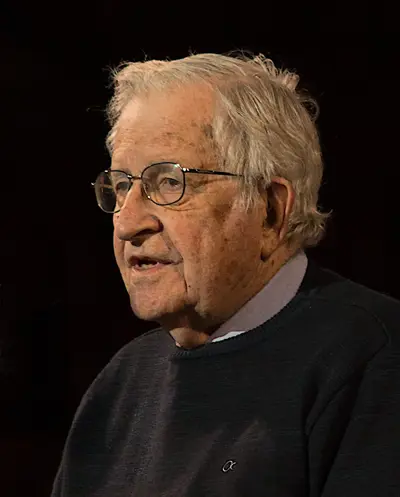
Avram Noam Chomsky is an American linguist, philosopher, cognitive scientist, historian, social critic, and political activist. Sometimes called "the father of modern linguistics", Chomsky is also a major figure in analytic philosophy and one of the founders of the field of cognitive science. He is Laureate Professor of Linguistics at the University of Arizona and Institute Professor Emeritus at the Massachusetts Institute of Technology (MIT), and is the author of more than 150 books on topics such as linguistics, war, politics, and mass media. Ideologically, he aligns with anarcho-syndicalism and libertarian socialism.
