Thomas Friedman Quotes
Every country has a part that is undeveloped.
Thomas Friedman, Foreign Affairs Columnist & Columnist, The Lexus and the Olive Tree, 2000
Sourced by: Eigen's Political and Historical Quotations


After traveling thorugh Virginia which was then the wealthiest and most developed of the slave states, he wrote ...


For almost a century this is an attack that conservative Republicans had made on Democrats. Yet the two greatest period of poverty, the Great Depression and the Great Recession occurred in Republican Administrations and recovery began under Democratic Presidents. The two great targets accused of wanting to spread the wealth around were Presidents Clinton and Obama In each case, the country was more affluent after 4 years of spreading the wealth, there were more jobs and average incomes were up—well better than when they took office from Republicans. There are two great theories of how wealth and prosperity is created. Conservatives argue that government should give money (or reduce tax burdens) and resources to the wealthy and they will invest it to create jobs and everyone will prosper. Liberals argue that the government should invest (spend money) in programs that strengthen the middle class and give them money or (reduce their tax burdens) and consumer spending which accounts for 70 percent of the economy will increase and the rich owners of the corporations will also make more money. Clearly both of these approaches seem to have worked at different times in American history; however, both of them have been failures at other times. (The George W. Bush and Jimmy Carter Administrations for example.) However, that is the political economic issue which must be decided by each American generation.


President Reagan had given one of his classic, optimistic speeches that connected so well with most of the public. In it he used the Winthrop Puritan metaphor of the "shining city on the hill"—an example that the world will look to in his description of America. His administration was the beginning of a long ear where the upper class grew wealthier and the standard of living of the poor actually decreased a little, which then evolved to the stage where the 1 percent accelerated their increase in wealth and even the middle class stagnated. Cuomo sounded the warning.


The problem she described has generally not been solved. The only thing that saved most of rural America is the remarkable increase in agricultural productivity, but that has become so good that farming requires fewer and fewer workers each year and migration to the cities has continued since before WWII. However to avoid higher city wages, unionization, higher taxes, and higher energy costs, many industrial operations deliberately moved to small or medium sized after WWII, and many communities then became one company towns. Then the companies would relocate elsewhere if the mover would save some costs, and the small towns who did get factories were again in the predicament that Mrs. Roosevelt describes. In the 1980s, off shoring eliminated the major job source for thousands of small towns and cities as well. Some cities and suburban areas attracted knowledge industry companies and jobs, but the small town problem is in much of America just as it was when Mrs. Roosevelt wrote this in her column in 1936.


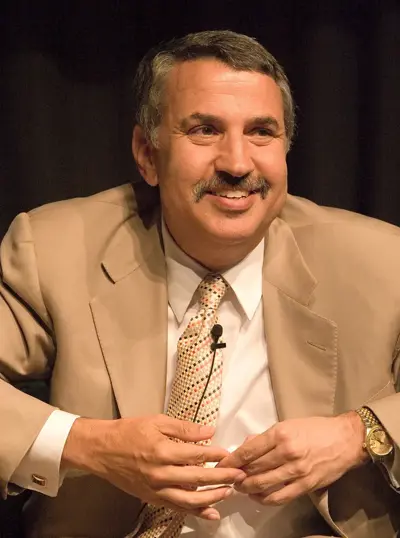
Thomas Loren Friedman is an American political commentator and author. He is a three-time Pulitzer Prize winner who is a weekly columnist for The New York Times. He has written extensively on foreign affairs, global trade, the Middle East, globalization, and environmental issues.
