Marcus Garvey Quotes
Ethiopia is now really stretching forth her hands. This great kingdom of the East has been hidden for many centuries, but gradually she is rising to take a leading place in the world and it is for us of the Negro race to assist in every way to hold up the hand of Emperor Ras Tafari.
The article is referred to by Rastafarians as the Prophecy by Marcus Garvey. The name of the religion derives from the Ethiopian Emperor Ras Tafari.
Marcus Garvey, 1887-1940, Black Nationalist Leader and Founder, Universal Negro Improvement Association, Article published in The Blackman, a Jamaican newspaper, November 8, 1930
Sourced by: Eigen's Political and Historical Quotations

The Negro World, Garvey’s Newspaper, was the country’s largest Black newspaper. The statement brought great distress to white Europe whose colonial interests were threatened.

This is the Holy Book of the Afro Athlican Constructive Church. This Afro-centric religion, founded in the 1920s in America considered Blacks the “sons and daughters of Ethiopia,” recognized Rogers as “Shepard” and Marcus Garvey as "Prophet and Apostle". The religion and The Holy Piby was so threatening to established Negro religions of the time that it was banned in Jamaica and other parts of the Caribbean. It is considered one of the fundamental religious sources for Rastafarians. It is often referred to as “The Black Man’s Bible.” It was translated from a “lost Amharic text” which tells of the lost tribe of Israel migrating to Ethiopia.

This was surprising for a man who owned slaves all his life.


While this document may seem a little pompous today, this was a monumental event for American Blacks and many others in the world. Garvey was as well known at the time as Martin Luther King Jr. and f were later.


The Roman Catholic Church in America had a very difficult problem with slavery. Catholics were themselves a minoirty, hated and distrusted by many Protestants. In most of the country, the distrusr was based on their large immigrant population, but in the South Catholic theology was hated and the Vatican and Pope were particular targets. The Catholic Clergy generally did not want to take sides in the most contentious issue in America since its inception. The Southern Catholic Clergy did not have that option as in the South, anyone who was not a supporter of slavery was an "enemy of the community and subject to all kinds of violence." Some Southern priests were willing to take the personal risk but did not want to put their followers at risk. In a strange consequence, Catholics--especially Irish Catholics--fought on both sides of the Civil War and often against each other. While it was not an exemplary moral behavior for the Church, there were difficult pressures on Catholic leaders. Further, most of the lowest and most difficult, undesirable jobs were filled by Catholics and most Catholic laymen so and end to slavery as the start of pitting the Catholics against the Blacks. So there was not a groundswell for abolition in most Catholic parishes even in the North.
The king was making his judgment that the English whites did not have the “gut” to kill the number of people and perpetuate the other cruelties to forcibly convert Black Africans to Christianity, and even if they did, it would be inconsistent with the moral tenets of the religion. He was not familiar with the Reformation persecutions of previous generations, nor did he anticipate the effect of colonialism by which large parts of Africa were culturally and religiously converted.

Abraham Lincoln in his famous eulogy to Clay in Springfield, IL, used this quotation.


For years this august reference publication perpetuated destructive ethnic myths such as this.
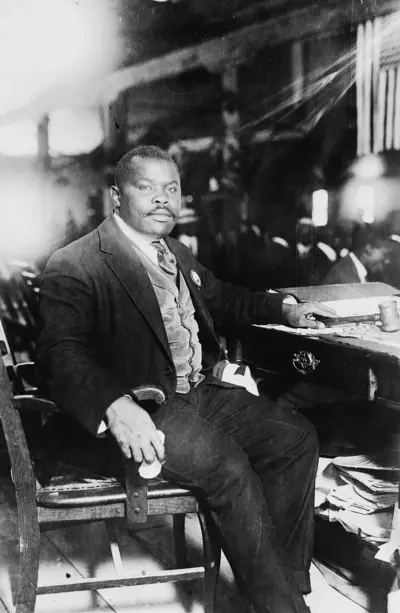
Marcus Mosiah Garvey Sr. ONH was a Jamaican political activist, publisher, journalist, entrepreneur, and orator. He was the founder and first President-General of the Universal Negro Improvement Association and African Communities League (UNIA-ACL, commonly known as UNIA), through which he declared himself Provisional President of Africa. Ideologically a black nationalist and Pan-Africanist, his ideas came to be known as Garveyism.
